

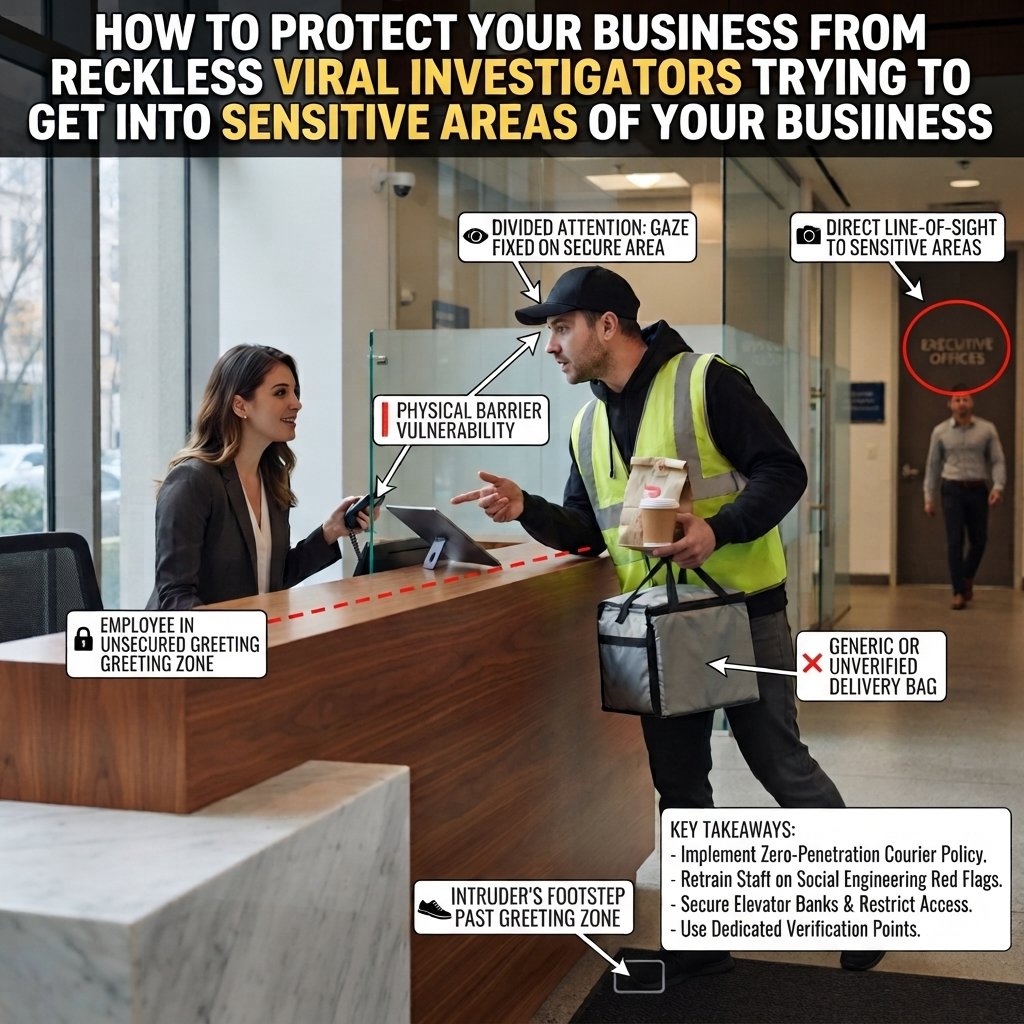
In modern commercial facility management, your greatest security vulnerability is rarely a picked lock or a breached exterior window. It is politeness.
When viral content creators like Benjamin Schneider (known online as “Reckless Ben”) or other undercover investigators target a corporate headquarters, they rarely resort to brute-force break-ins. Instead, they weaponize the ordinary friction of daily business operations. By dressing as gig-economy couriers and carrying food or packages, they bypass physical security through social engineering, a manipulation technique to exploit human psychology, rather than technical vulnerabilities, to trick individuals into divulging sensitive information, granting system access, or performing actions that compromise security.
For operations directors, analyzing these infiltrations reveals exact systemic breakdowns—and provides a clear blueprint for how to lock down your lobbies permanently.
While the author and team at Operations World does not condone the business practices that attracted the attention of the viral investigators, we look at the operational failures to see what happened and what could be learned.
Case Study: The Food Delivery Proxy and Lobby Exploitation
What Happened
In high-profile investigations targeting corporate facilities, creators have utilized a deceptively simple tactic: walking through front security holding an everyday delivery item—such as a burrito or a takeout bag—ostensibly looking for an executive or employee inside.
Disguised as a standard food delivery driver, the intruder approaches the reception desk. While engaging the front desk receptionist in casual, hurried dialogue about a missing suite number or an urgent drop-off, they slip past the primary security barrier. Once past the reception desk, they navigate unhindered down private executive corridors, recording concealed-camera footage of internal workspaces before anyone realizes they do not belong.
Why Frontline Defenses Failed
- The “Helpfulness” Trap: Reception and concierge staff are psychologically and professionally conditioned to be accommodating. When presented with a delivery uniform or a food bag, their default instinct is helpfulness, not hostility. They assume couriers are temporary, low-threat entities.
- Operational Blind Spots in Lobby Flow: Many commercial offices separate the public reception area from interior hallways with only a waist-high glass partition or an unlocked glass door. Once a visitor steps past the greeting zone during a busy shift change, they enter unmonitored lateral space.
- Absence of Verifiable Hand-Off Points: Facilities that lack a secure, isolated vestibule force front-desk staff to choose between letting a courier wander in or blocking the main corridor entirely. Without a designated drop zone, the path of least resistance wins.
How Can Facility Operations Protect Against Social Engineers
Preventing social engineering attacks requires removing human guesswork from the equation. Frontline workers should never have to guess whether a person holding a food bag is an actual courier or an undercover creator filming an ambush.
1. Implement a Zero-Penetration Courier Policy
- The Rule: No gig-economy food delivery driver, florist, or unverified courier ever passes the primary reception barrier.
- The Operation: Establish a strict lobby drop-off shelf or secure vestibule lockers located entirely outside the secure perimeter. If an employee orders lunch, they must come down to the lobby to collect it. Couriers do not enter executive floors, breakrooms, or interior office wings under any circumstances.
2. Deploy Layered Access Control & Turnstiles
- Physical Zoning: Separate your public lobby from your secure workplace core using optical turnstiles, biometric readers, or floor-to-ceiling glass security doors.
- Elevator Interlocks: Integrate badge access readers directly into elevator banks. Even if someone slips past a ground-floor lobby desk, they cannot call an elevator to executive floors without a programmed employee access card.
- Security Escort: Should the delivery worker’s nature of work requires access to staff areas (eg. large item delivery), escort from relevant staff member or security member should be provided at all times to ensure they do not wander into sensitive areas.
3. Retrain Frontline Staff on Social Engineering Red Flags
- Behavior Over Appearance: Train receptionists to look past the clothes and props (high-vis vests, delivery bags, clipboards) and focus on behavior. Does the visitor refuse to state who ordered the delivery? Are they overly fixated on locating specific C-suite offices rather than dropping off a package?
- The “Stop & Verify” Protocol: If a courier attempts to move past the reception desk, staff must be empowered to issue a firm, immediate challenge: “Stop right there. Deliveries must remain at the front desk. Who is the recipient?”
By transforming your lobby from an open hospitality zone into a controlled, zero-trust perimeter, you neutralize the Trojan horse strategy entirely by keeping your workspace secure and your operations out of the viral spotlight. It is important to note that a determined investigator trying to find access will try other ways and it is important to work with your security and legal team to know your options in handling unauthorized access.