

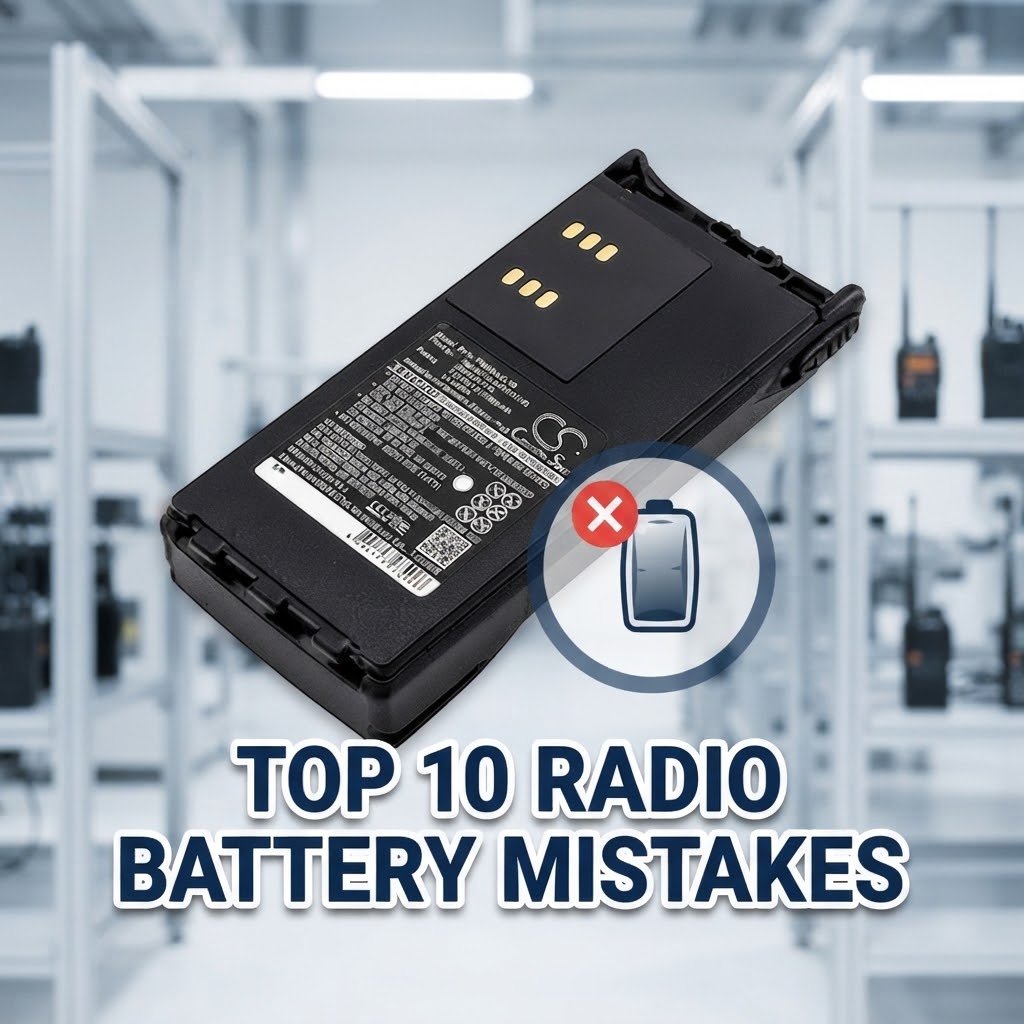
In any industrial, commercial, or campus-based facility, reliable communication is the invisible backbone of
daily workflow. When an emergency strikes, or when maintenance crews need to coordinate a rapid response
across a massive operational footprint, two-way radios are the frontline tool. Yet, facility managers often find
their communication fleets failing prematurely. While equipment error could be a reason, often times it comes down to poor handling, charging, and deployment habits surrounding two way radio batteries.
Modern lithium-ion and nickel-metal hydride power cells require disciplined operational management. When
operations teams treat radio power sources as indestructible commodity items, they invite unexpected
downtime, safety hazards, and inflated replacement budgets. Below are the 10 most critical mistakes
operations teams make regarding two way radio batteries, along with best practices to correct them in a
professional setting.
- Procuring Cheap, Non-OEM Aftermarket Batteries
When fleet expansion or budget tightening occurs, procurement departments often look for ways to cut
corners. Buying unbranded, third-party aftermarket replacement packs instead of Original Equipment
Manufacturer (OEM) cells is a major pitfall. While third-party packs may cost half as much upfront, they
frequently lack rigorous internal protection circuitry, use inferior cell chemistries, and fail to maintain consistent
voltage under heavy transmit loads. Furthermore, cheap aftermarket batteries are significantly more prone to
premature swelling and thermal runaway, posing serious safety risks in industrial environments. - Neglecting Multi-Unit Charger Maintenance and Diagnostics
Operations teams invest heavily in multi-unit desktop charging banks, but once they are plugged into shift
desks, they are rarely inspected. Over time, charging bays accumulate dust, metallic debris, and oxidation on
their spring-loaded contact pins. Dirty charging terminals cause high electrical resistance, leading to erratic
charging cycles, false “fully charged” indicators, or complete charging failure. Facility managers should
implement a monthly cleaning protocol using isopropyl alcohol and cotton swabs on all charging bay contacts. - Failing to Cycle or Manage Seasonal/Backup Radio Fleets
Many facilities maintain caches of emergency backup radios or seasonal units used only during peak
operational windows or plant turnaround periods. Leaving these units sitting idle in lockers or storage cages
for months without maintenance is disastrous. Batteries left completely unmanaged will self-discharge, sink
into deep voltage depletion, and eventually trip their internal Battery Management System (BMS) into a
permanent lockout state. Backup fleets must be rotated, charged, and checked on a quarterly schedule.
A comprehensive guide for facility managers, safety directors, and industrial operations teams. - Ignoring Environmental Temperature Extremes on Shift Racks
Where charging stations are located matters immensely. Placing multi-unit chargers in unconditioned
warehouses, loading dock alcoves, or sub-zero outdoor security shacks subjects two way radio batteries to
extreme thermal stress. Charging lithium-ion cells in temperatures below freezing causes irreversible metallic
lithium plating inside the anodes, creating permanent internal short-circuit hazards. Conversely, baking radios
in direct sunlight on dash chargers or in stifling mechanical rooms degrades cell capacity rapidly. - Skipping Routine Contact Cleaning on Radio Housings
Just as charging bays get dirty, the metallic contact pads on the back of the radios and battery packs
accumulate grease, sweat, dust, and grime from daily handling. Operators frequently submit maintenance
tickets reporting “dead batteries” when the issue is simply dirty contact surfaces preventing proper power
transfer. Establishing a quick quarterly inspection to clean both radio and battery contacts prevents frustrating
communication dropouts on the floor. - Overusing High-Power Transmit (Hi-P) Mode for Local Comms
Two-way radios typically feature adjustable power output settings—usually High Power (4 to 5 watts) for wide-area coverage and Low Power (1 to 2 watts) for close-range or intra-building communication. Operators working inside a single building or immediate plant floor often leave their units permanently locked on High Power. This draws aggressive current spikes, heats up the battery pack unnecessarily, and drains capacity in a fraction of the shift, forcing mid-shift battery swaps that disrupt workflow. - Permitting Deep Discharge and “Soft-Off” Drain States
Running a radio until it cuts out completely from low voltage, and then throwing it back into a drawer without recharging, is a lethal habit for modern chemistry cells. Even when switched off via a soft-touch power knob many modern digital radios draw a minute “phantom current” or standby power to maintain internal registers and quick-wake features. Left unattended, this slow drain pushes the cell voltage past the critical safety threshold, resulting in a battery that smart chargers will outright reject. - Lacking Lifecycle Tracking and Age Management
Unlike heavy machinery that undergoes scheduled preventative maintenance, two-way radio batteries are usually kept in service until they outright fail or refuse to hold a charge for more than an hour. However, lithium-ion cells have a finite chemical lifespan—typically 2 to 3 years of heavy daily cycling—regardless of how well they are maintained. Operations teams should stamp deployment dates on new battery packs or implement a simple asset-tagging system to retire packs that have exceeded their functional window before they fail during a critical incident. - Flawed Storage Protocols During Facility Shutdowns
During facility turnarounds, seasonal shutdowns, or extended holiday closures, operations teams sometimes pack away fully charged radio fleets or leave them plugged into chargers indefinitely. Storing lithium-ion batteries at 100% state-of-charge accelerates chemical degradation and capacity loss. The correct storage protocol for any extended downtime is to discharge or charge the packs to approximately 40% to 50% capacity and store them in a climate-controlled environment. - Mishandling and Failing to Recycle Swollen or Compromised Cells
Perhaps the most dangerous mistake is ignoring physical warning signs. When a battery pack begins to warp, bulge (“pillow”ing), or emit a chemical odor, it indicates internal gas buildup from electrolyte breakdown. Continuing to jam a swollen battery into a radio housing or charging bay is a severe fire hazard. Operations teams must enforce strict safety protocols: immediately remove swollen packs from service, store them in fireproof containment, and send them to certified e-waste recycling facilities.
Pro-Tip for Operations Leaders: Standardizing your fleet maintenance schedule can dramatically reduce
unexpected communication failures. For deeper insights into streamlining plant workflows, explore our curated
facilities communications page.
Conclusion
Optimizing the lifespan and reliability of your two way radio batteries requires a shift from reactive replacement
to proactive asset management. By eliminating these ten common operational mistakes, facility teams can
ensure uninterrupted connectivity, enhance worker safety on the floor, and significantly reduce long-term
procurement costs.