

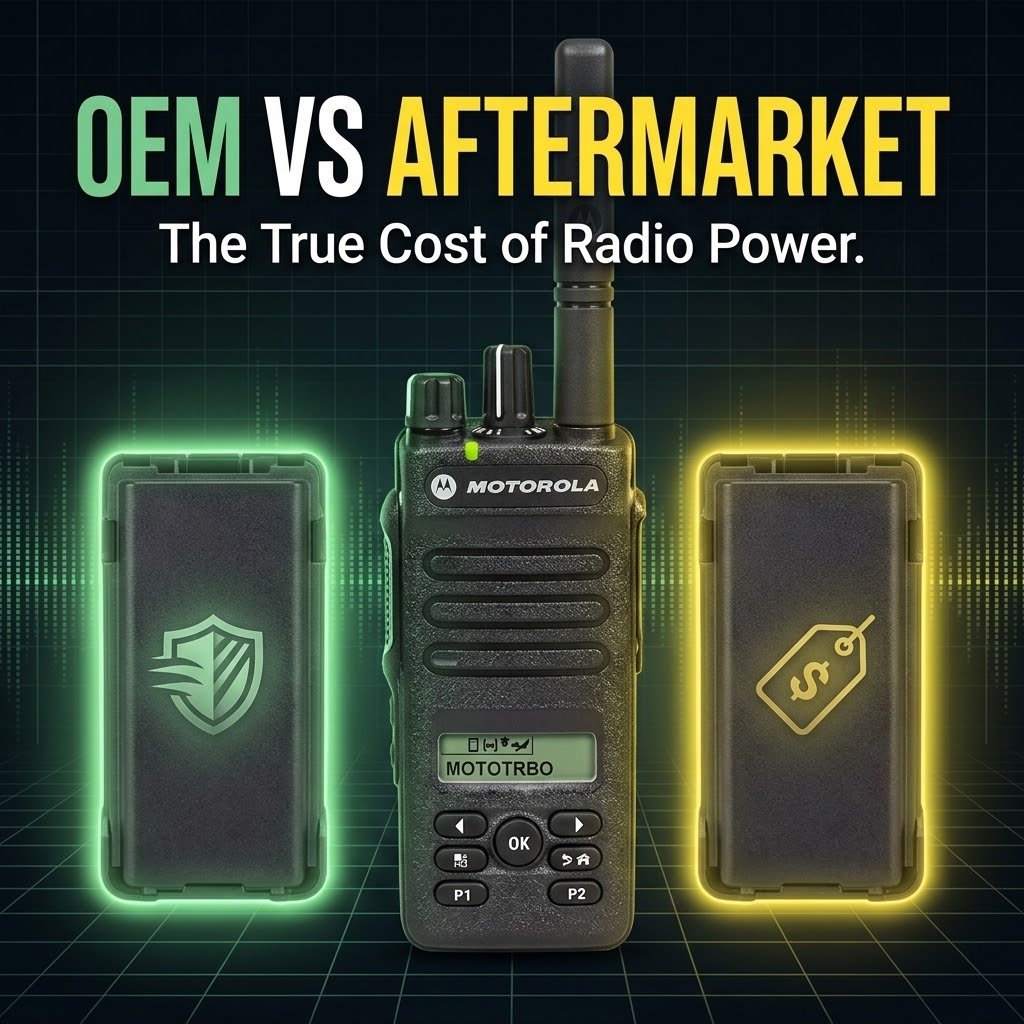
When managing commercial facilities, industrial plants, or multi-site enterprises, instant two-way communications are the backbone of daily operations and crisis response. Facility directors invest thousands of dollars in commercial-grade two-way radios—such as Motorola MOTOTRBO (XPR 3000/7000 series), CP200d, or APX series—to ensure seamless coordination across security, maintenance, and executive teams.
However, when fleet batteries inevitably reach the end of their service life, procurement directors face a major financial decision: do you pay premium prices for Original Equipment Manufacturer (OEM) Motorola batteries, or do you deploy third-party aftermarket replacements at a 30% to 60% discount?
While lower initial unit pricing is attractive to budget-conscious managers, evaluating Motorola radio batteries requires looking far beyond the upfront purchase order. You must weigh real-world performance, charging ecosystem intelligence, hazardous location safety certifications, and overall Total Cost of Ownership (TCO).
1. Capacity Ratings & Real-World Operating Life
Battery capacity is measured in milliampere-hours (mAh), dictating how long a radio operates on a single charge based on the industry-standard 5-5-90 duty cycle (5% transmit, 5% receive, 90% standby).
| Feature / Metric | OEM Motorola Batteries | Tier-1 Aftermarket | Generic / Knockoff Aftermarket |
| Capacity (mAh) Truth | Strictly rated; matches or exceeds label specs | Generally accurate to label specs | Frequently inflated (e.g., claims 3000 mAh, delivers 1800 mAh) |
| Cell Quality | Premium Japanese/Korean cells (Panasonic, Sanyo) | Grade-A Japanese or Chinese cells | Low-grade, high internal resistance budget cells |
| IMPRES™ Smart Tech | Native full integration with IMPRES 1 & 2 chargers | Varies (Some have reverse-engineered chips; many lack chips) | No smart chip; charges as “dumb” battery |
| HazLoc / UL 913 Certified | Fully certified for hazardous environments | Available on select specific models | Non-existent; extreme safety hazard |
| Warranty Coverage | 12–24 months (includes capacity guarantees) | 12–24 months (reputable brands) | 30–90 days (difficult supplier recourse) |
| Initial Cost per Unit | $90 – $180+ | $45 – $85 | $18 – $35 |
Capacity Degradation Under Load
Motorola OEM batteries use top-tier lithium-ion (Li-Ion) cells engineered to maintain voltage stability even during high-power 5-Watt RF transmissions. Generic aftermarket options often suffer from significant voltage sag during transmission. Even if a generic battery shows “full charge” on the radio display, pressing the Push-To-Talk (PTT) button can trigger a voltage drop that forces the radio to reset or drop the call prematurely.
2. Smart Battery Ecosystems: Motorola IMPRES™ vs. Third-Party
One of Motorola’s primary differentiators is its proprietary IMPRES™ (Integrated Motorolas Portable Radio Energy System) charging technology. IMPRES batteries contain internal microcontrollers that communicate directly with IMPRES chargers to log:
- Cumulative charge cycles
- Real-time capacity health
- Automated reconditioning requirements to eliminate memory effect
The Aftermarket Disconnect
When you drop an OEM IMPRES battery onto an IMPRES multi-unit charger, the charger reads the battery’s microchip and adjusts the charge current, preventing overcharging and extending service life up to 150+ cycles beyond standard batteries.
Most aftermarket batteries lack genuine IMPRES chips. When placed on an IMPRES charger:
- The charger defaults to a generic “dumb” charge profile.
- The automated reconditioning cycle is bypassed.
- Fleet management software (such as Motorola IMPRES Fleet Management) loses visibility into battery health, leaving facility directors unable to track which batteries are near failure.
3. Safety Certifications: HazLoc, UL, and TIA-4950 Compliance
For facility managers overseeing chemical plants, manufacturing facilities, facilities with grain/dust hazards, or natural gas utilities, battery selection is a major life-safety compliance requirement.
Intrinsically Safe (IS) Requirements
Motorola radios used in volatile environments are certified under UL 913 / TIA-4950 standards for Hazardous Locations (HazLoc Class I, II, III, Division 1). This ensures the radio and battery assembly cannot generate a tiny electrical spark or thermal hotspot capable of igniting airborne dust or flammable gases.
- OEM Guarantee: Motorola HazLoc batteries undergo rigorous drop, thermal, and short-circuit testing alongside the specific radio chassis.
- The Aftermarket Risk: Using a non-certified aftermarket battery on a HazLoc-rated radio instantly voids the radio’s intrinsic safety rating. If an industrial incident occurs, deploying unapproved batteries in classified environments creates massive OSHA compliance violations and severe legal liability.
4. Warranty Implications & Radio Protections
A common misconception among procurement officers is that using an aftermarket battery completely voids the original Motorola warranty on the radio body itself.
The Legal Nuance vs. Real-World Practice
Under the US Magnuson-Moss Warranty Act, a manufacturer cannot void a device’s warranty simply because a third-party accessory was used—unless the third-party accessory directly caused the failure.
However, in practice:
- If a cheap aftermarket battery leaks, swells, overheats, or shorts out the internal motherboard of a $1,200 MOTOTRBO radio, Motorola will deny the repair claim.
- You must then rely on the aftermarket battery vendor’s warranty to replace the damaged radio—a promise that low-cost or off-shore suppliers rarely honor.
5. Total Cost of Ownership (TCO) Analysis
To determine true cost efficiency, operations managers must evaluate the cost per user per month rather than purchase price alone.
SCENARIO: 50-Radio Fleet Over a 3-Year Lifecycle

Option A: OEM Motorola IMPRES (XPR 7000 Series)
• Initial Cost: 50 batteries @ $120 = $6,000
• Expected Lifespan: 30–36 months (due to IMPRES reconditioning)
• Failure/Replacement Rate: < 2%
• 3-Year Total Cost: ~$6,120

Option B: Generic Aftermarket (Online Marketplace)
• Initial Cost: 50 batteries @ $30 = $1,500
• Expected Lifespan: 10–14 months (rapid capacity fade)
• Replacements Needed: 2 additional sets over 3 years = $3,000
• Premature Failure/Defect Rate: 15–20% ($900 additional)
• 3-Year Total Cost: ~$5,400 + Hidden Staff Downtime Costs
While Option B appears to save $720 over three years, it introduces operational friction: mid-shift battery failures, uncoordinated drop-offs, potential safety hazards, and increased administrative overhead.
The Operations Director’s Decision Matrix
When building your procurement strategy, apply this vendor-neutral framework to choose the right battery path for your facility:
- Mission-Critical & Hazardous Sites (Safety First): Always specify OEM Motorola HazLoc/IMPRES batteries. The safety compliance, explosion-proof rating, and reliability outweigh all cost considerations.
- Standard Commercial Operations (Balanced Budget): If utilizing aftermarket options, restrict purchases strictly to Tier-1 certified manufacturers that provide written radio-damage indemnification warranties and true UL testing certificates. Avoid unbranded or generic marketplace listings completely.
- Fleet Audit Practices: Ensure your team runs bi-annual capacity audits on all radio power packs to decommission units operating below 80% original rated capacity.
For a deeper dive into establishing standardized operating procedures, communication fleet management templates, and vendor-neutral frameworks for evaluating radio equipment at scale, explore our curated communications resources on OperationsWorld.