

For commercial facility managers and retail operations directors, the intersection of street-level crime, government benefits administration, and independent digital journalism represents a growing operational threat. When an undercover camera enters your store, a single transaction can be transformed into a national viral headline in hours.
The recent controversy surrounding Lam’s Seafood Asian Market in Seattle’s Chinatown-International District and independent investigator Nick Shirley offers an invaluable, real-world case study. While there are many commentators talking about the fraud or the reporting practices, in this article, we are strictly looking at the operational aspect of lam’s Seafood team.
By dissecting the mechanics of the incident, the store’s history, and the management team’s response from an operational perspective, operations leaders can extract critical lessons on risk management, register-level compliance, and crisis communications.
The Event: What Happened Inside Lam’s Seafood
In October 2026, independent reporter and influencer Nick Shirley published an investigative video documenting alleged Electronic Benefit Transfer (EBT/Supplemental Nutrition Assistance Program) benefit trafficking in Seattle.
The Transaction Mechanics
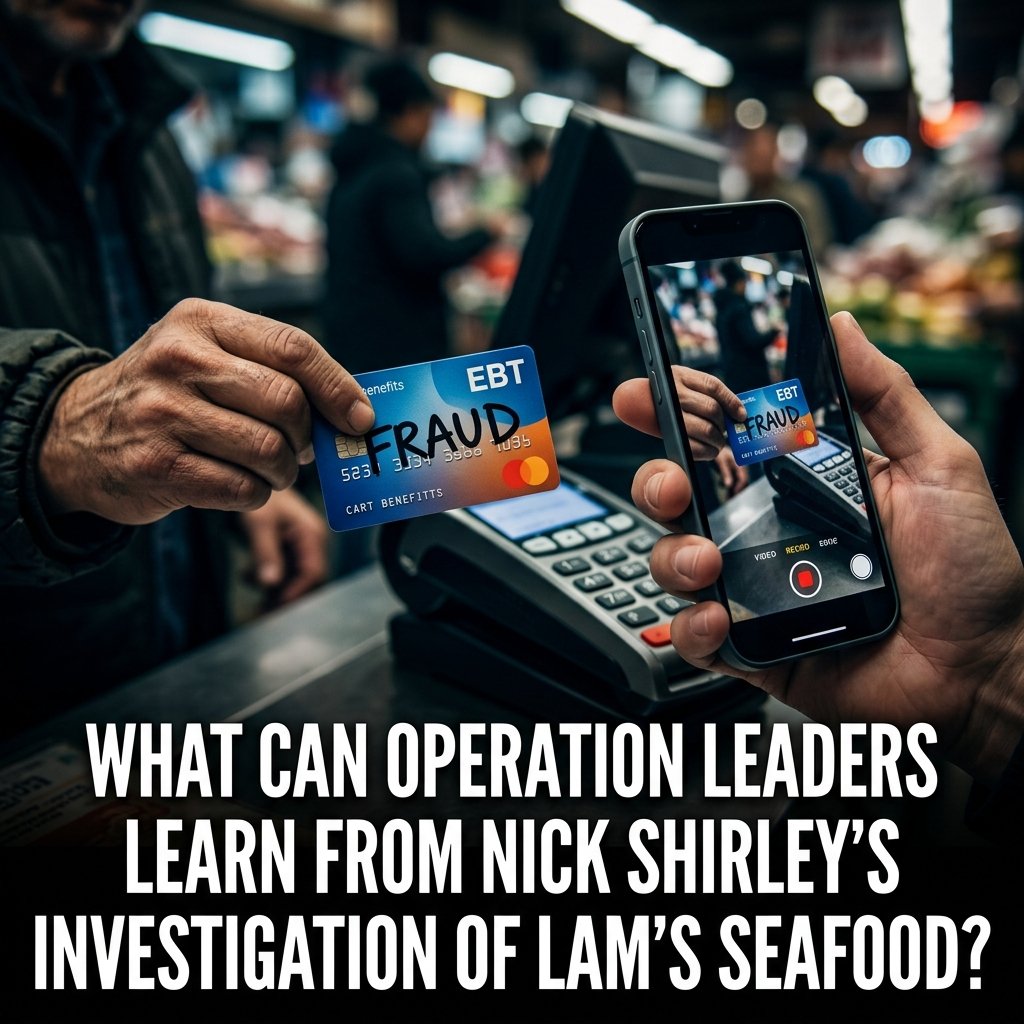
- The Infiltration: Shirley is led by a woman, running an alleged exchange EBT benefits for cash deal, to Lam’s Seafood Market. Shirley held an EBT card on camera while the woman initiated a register purchase.
- The Item Controversy: The viral footage showed a single can of Spam on the checkout counter while the Point of Sale (POS) register terminal displayed a total charge of approximately $120 from a case of luncheon meat and one other item. Shirley questioned on camera why a single can of meat cost $120, framing the interaction as potential food stamp fraud or kickback trafficking.
- The Outcome: The transaction failed at the register because Shirley and the woman did not have the correct Personal Identification Number (PIN) for the EBT card. The parties left the store without collecting any bulk goods, and no EBT funds were actually transferred to the market.
- The Return: Shirley and his cameraman returned to the store and started asking the staff questions on why they are committing fraud. Most of the staff who are immigrants and not understanding what he’s asking just said ‘yes’ to get him to go away.
What Lam’s Seafood Was Working With: The Operational Context
To evaluate the situation fairly, operations managers must understand the environmental and structural realities Lam’s Seafood faced prior to the filming:
1. High-Risk Geographic Corridor
Lam’s Seafood operates in an urban commercial zone long impacted by open-air street markets, illicit drug trade, and informal cash economies. Third-party benefit traffickers routinely frequent high-volume grocery corridors across major metropolitan areas, seeking to buy EBT cards from recipient cardholders at a discount and redeem them for bulk non-perishable goods or cash.
2. Historical Drag in Law Enforcement Filings
Because Lam’s Seafood is a major bulk grocer in the district, third-party bad actors have historically used the store as a destination to redeem illicitly purchased or traded EBT cards.
- The Distinction: Municipal police and federal agency court filings have previously listed Lam’s Seafood as a location linked to broader regional EBT trafficking networks. However, government law enforcement investigations have never cited or charged Lam’s Seafood, its owners, or its management as knowing co-conspirators in EBT fraud. The market previously cooperated fully with law enforcement, providing security camera footage and register logs.
3. Language & POS Operational Realities
In ethnic and specialty bulk supermarkets, inventory handoffs frequently differ from standard retail:
- Bulk Ordering: In this case, the customer requested a full 24-can case of Spam in Vietnamese from the cashier. Because bulk cases are stored in the back stockroom, cashiers ring up the entire case at the terminal while a floor clerk fetches the box. A single display can was placed on the counter for scanning.
- Language Barriers: The cashier interacting with Shirley and the buyer was focused on processing the payment and navigating a multi-lingual transaction, leaving them unaware that they were being filmed for an investigative story.
Operational Breakdown: What Lam’s Seafood Did Well
When the video aired and generated immediate online backlash—including phone harassment and an estimated 8% to 10% drop in store traffic—Lam’s management team took deliberate operational and PR steps to defend their business.
1. Technical Fact-Based Rebuttal
Operations Manager Teizi (Stacy) Mersai quickly analyzed the store’s POS terminal data and store surveillance. Management publicly highlighted two critical facts that disproved complicity:
- The Failed Transaction: No money changed hands because the system denied the PIN.
- The Stockroom Log: The $120 total reflected a wholesale 24-pack case order requested verbally in Vietnamese, not a $120 single can.
2. Transparent Media Engagement Over Silence
Instead of issuing a generic “No Comment” or shutting down communications, Lam’s invited established regional news outlets (such as KING 5 and KIRO 7) into the building. They allowed journalists to review checkout procedures, view back-room stock areas, and interview management on camera, effectively countering the viral narrative with verifiable operational context.
3. Re-Anchored the Brand Around Community Service
When critics suggested the store eliminate EBT processing entirely to avoid future scrutiny, management took a clear operational stance:
“If we discontinue it, we will have succumbed to that problem. The vast majority of EBT users at our market are legitimate local residents. Why would we penalize them?”
This reinforced customer loyalty and positioned the store as an essential neighborhood institution standing up against regional crime rather than profiting from it.
Where Operational Defenses Broke Down
Despite an effective post-event PR recovery, the incident exposed several operational vulnerabilities prior to and during the filming:
1. Lack of Register-Level Incursion Protocols
The front-line cashier had no training on how to handle recording devices or suspicious, multi-party benefit transactions at the register. The cashier repeatedly retried the transaction while being filmed without pausing to call a supervisor or enforce store filming policies.
2. Failure to Proactively Address Historical Reputation Drag
Because Lam’s had been cited in prior police affidavits as a location where street-level traffickers attempted to redeem benefits, management should have anticipated that undercover reporters or investigators would target their registers. Operating in a known high-risk environment without heightened register-verification protocols left them exposed to ambush reporting.
3. Slow Initial Digital Containment
In modern retail, a video reaches millions of views within 24 hours. While Lam’s eventually released strong counter-reporting and social media walk-throughs, the multi-day lag allowed initial claims to result in direct revenue loss and employee stress before the store’s explanation was widely distributed.
Actionable Playbook for Operations Directors
The Lam’s Seafood case provides a clear roadmap for facility directors operating commercial, retail, or public-serving locations in high-scrutiny or high-crime environments.
1. Implement Register & Point-of-Sale Guardrails
- Third-Party Card Rules: Train checkout staff to strictly enforce standard PIN-pad procedures. Cashiers should never assist, process, or re-try EBT cards if the individual at the register does not know the PIN or appears to be acting under the direction of an unverified third party standing nearby.
- Bulk Item Verification Protocols: If a store utilizes “scan one display item for a case in the back” procedures, the cashier staff should confirm with the customer that this is for a case of merchandise and the POS systems should explicitly display “CASE QTY: 24” on the customer-facing screen to eliminate visual confusion for observers or cameras.
2. Establish Frontline Camera & Investigation Protocols
- The “Pause and Escalate” Button: Cashiers must be trained to immediately pause a transaction and call a manager if a customer or accompanying party begins filming the register screen, acting erratically, or making accusations of fraud.
- Support Frontline Staff: In the event of an ambush, protect frontline employees from public harassment. Lam’s cashier required time off due to distress from the viral exposure. Operations directors must have shift-coverage contingencies ready.
3. Conduct Preemptive Reputation & Legal Audits
- Know Your Facility’s History: If your facility address has appeared in municipal police reports, code enforcement filings, or past neighborhood investigations, assume that information is public knowledge.
- Maintain Auditable Digital Trails: Ensure your CCTV footage, register logs, and inventory manifests are archived and retrievable within 1 hour. When allegations arise, the ability to produce complete digital transaction logs is your fastest operational defense.
4. Build a Rapid Response Media Protocol
- Do not wait for a viral video to peak before responding. Prepare pre-approved media routing cards, establish direct lines to local news stations, and ensure your PR team can record and publish a clear, fact-based walk-through of your facility within 12 to 24 hours of an incident.
By treating register-level compliance, physical security, and public relations as an integrated operational system, facility directors can successfully defend their business, protect their employees, and maintain community trust under the modern media spotlight.