

THE ANSWER
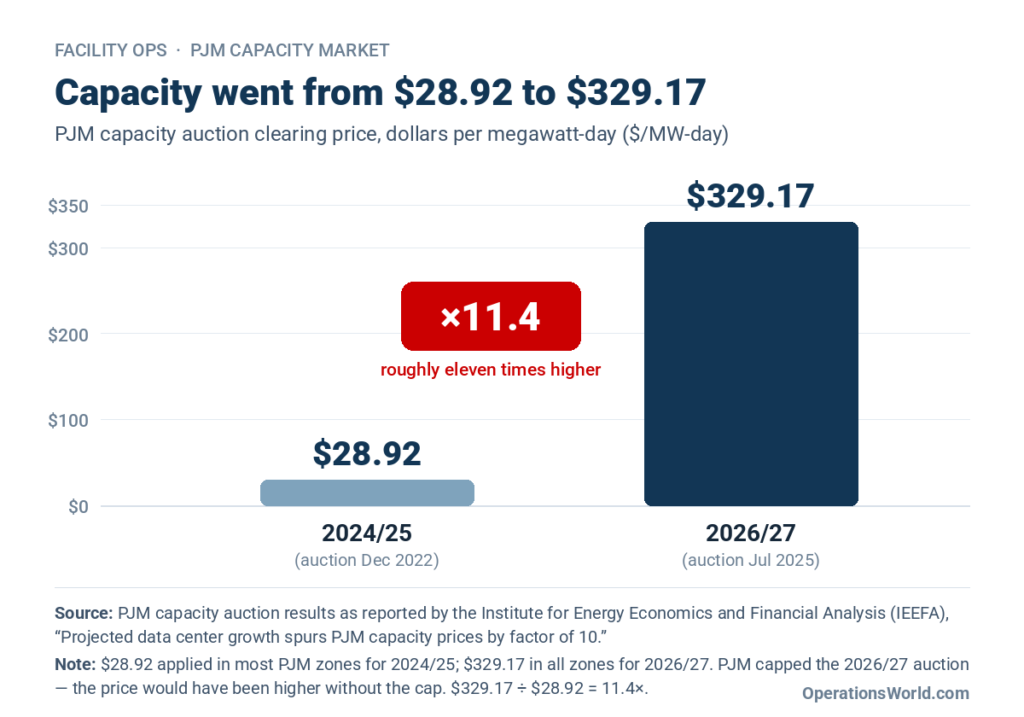
If your usage fell and your bill still rose, the part of the bill that moved is probably not the part tied to usage. An electric bill has four blocks — energy, demand, capacity, and delivery — and only the first one follows your kilowatt-hours. In 2026, the sharpest increase sat in capacity: in the PJM market, the price of reserving generation for peak demand went from $28.92 per MW-day in the 2024/25 auction to $329.17 per MW-day for 2026/27 — roughly eleven times higher in a single line item. A building can do everything right on efficiency and still pay substantially more. The fix starts with diagnosis: find which block moved before you spend anything.
A bill is four bills stapled together
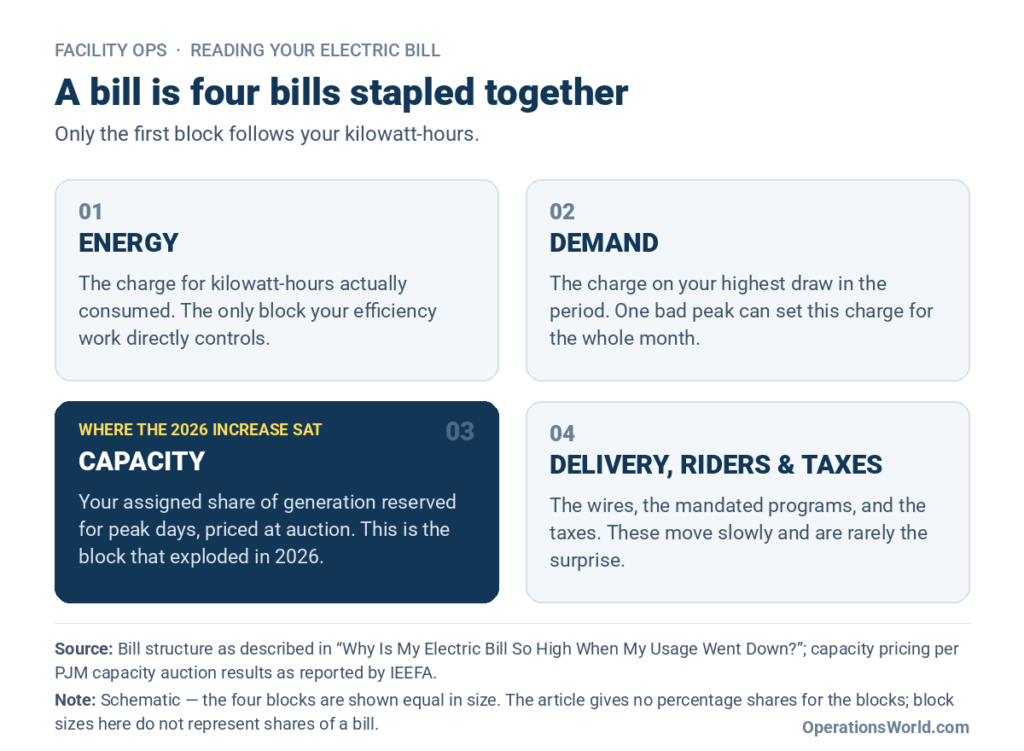
Most bill shock comes from comparing totals. Totals hide the story. Separate the invoice into its four blocks and compare each one against the same month last year:
- Energy — the charge for kilowatt-hours actually consumed. This is the only block your efficiency work directly controls.
- Demand — the charge on your highest draw in the period. One bad peak — a Monday-morning startup with everything running at once — can set this charge for the whole month.
- Capacity — the charge for your assigned share of generation reserved for peak days. In PJM it is set by how much your building drew at the system’s peak moments, priced at auction. This is the block that exploded in 2026.
- Delivery, riders and taxes — the wires, the mandated programs, and the taxes. These move slowly and are rarely the surprise.
When facility managers run this comparison on a 2026 bill, the pattern repeats: block one is flat or down — the efficiency work is real, and it shows — while blocks two and three carry the entire increase. That is not a billing error. It is the signature of capacity-driven pricing.
Why capacity moved so far, so fast
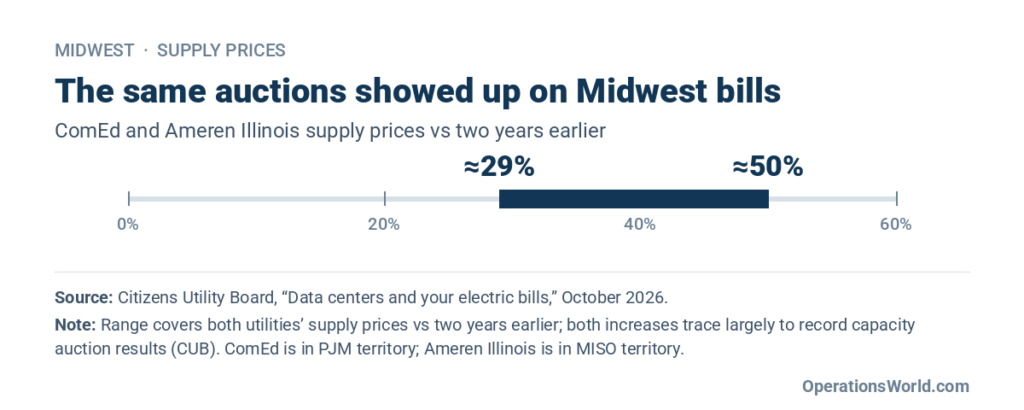
Capacity prices are set by auction, years ahead, on expected peak demand. The PJM auctions cleared at $28.92 per MW-day for 2024/25 and at $329.17 per MW-day for 2026/27. Supply prices followed the same auctions upward: in the Midwest, supply in ComEd and Ameren territories has been reported at roughly 29–50% higher than two years earlier, largely attributed to the capacity auctions.
Two cautions belong with those numbers. First, the auction prices are PJM-specific — if your building sits in another market, your capacity or demand mechanism has a different name and a different price, but the diagnostic method is identical. Second, check your supply contract before blaming the tariff: many contracts pass capacity costs straight through, which means the increase arrives even on a contract sold as protection against rising prices.
Source: PJM capacity auction results as reported by the Institute for Energy Economics and Financial Analysis (IEEFA); Citizens Utility Board analysis, 2026.
What to do about a bill that rose while usage fell
Work in this order — it is cheapest first, and each step tells you whether the next one is worth doing.
- Rebuild the comparison. Take this year’s and last year’s bills for the same month and split both into the four blocks. Ten minutes with the two invoices answers the “what happened?” question better than any total.
- Find your capacity obligation. It is printed on the invoice, along with the price applied to it. Compare the obligation and the price across the two years — usually one of them is the whole story.
- Read the pass-through clause. Pull your supply contract and check how capacity is treated. If it passes through, renewal timing and contract structure are now levers, not paperwork.
- Watch your peaks, not just your usage. Because demand and capacity both key off peak behavior, staggering startups and shedding load at peak moments can move next year’s charges in a way that using fewer total kilowatt-hours cannot.
- Brief finance with the block comparison. One page, four blocks, two years. It converts an argument about a shocking total into a decision about specific charges.
None of this requires a capital project. It requires reading the bill the way the utility wrote it — as four separate charges that happen to arrive on one page.
KEY TAKEAWAY: A rising bill with falling usage is not failed efficiency work. It is capacity and demand pricing doing exactly what it is designed to do — and it is diagnosed by line item, not by totals.