

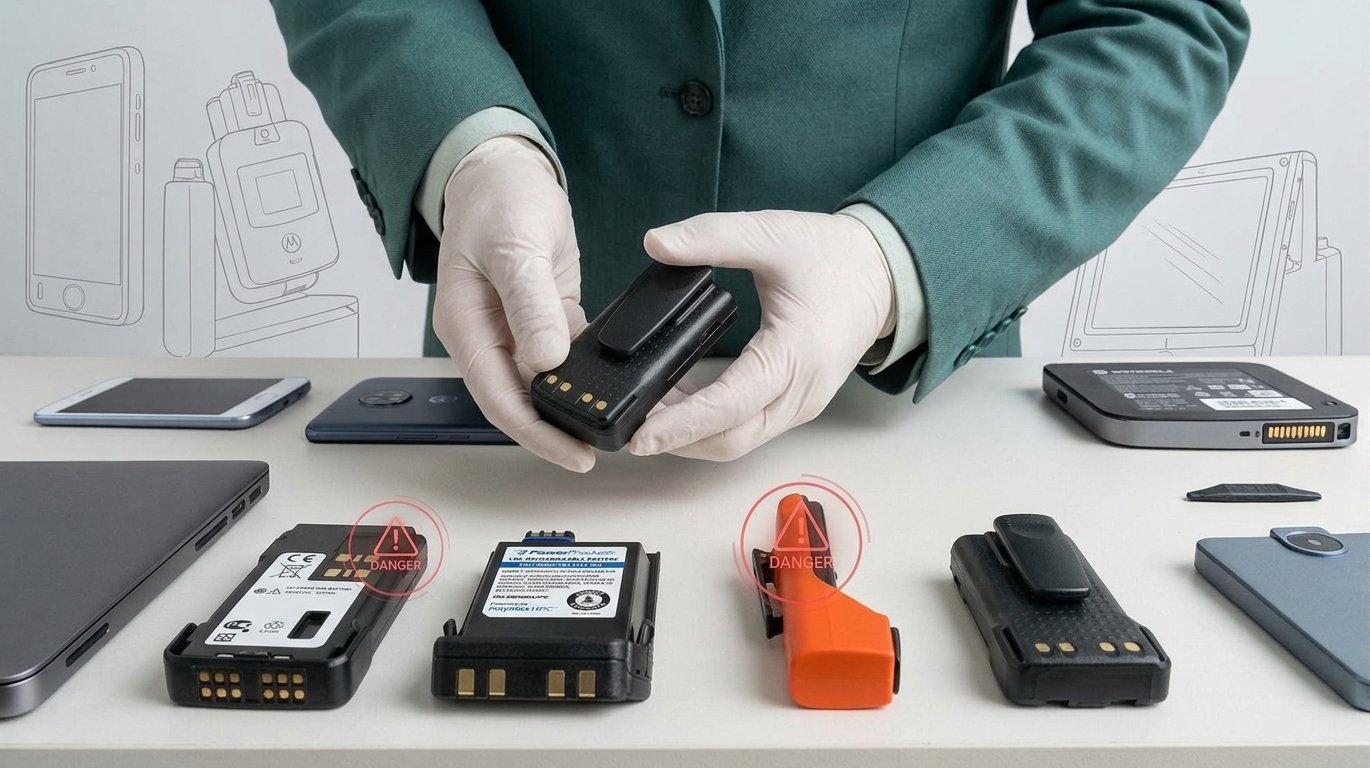
When managing hundreds of handheld radios across a campus, municipal fleet, or industrial facility, replacement battery costs mount quickly. Original Equipment Manufacturer (OEM) packs carry heavy price tags, leading many facility managers to consider third-party alternatives.
Going aftermarket isn’t inherently bad—it can yield 30% to 40% in CapEx savings. However, buying based strictly on price-per-unit is an operational trap. Low-tier, unbranded replacement batteries often lack basic safety circuits, fail to hold a charge mid-shift, and create severe liability risks.
To protect both your budget and your operational uptime, adopt a specs-first evaluation framework when vetting third-party battery vendors.
Step-by-Step Vendor Selection Framework
Moving past initial unit pricing requires evaluating three core pillars: cell provenance, safety engineering, and vendor accountability.
1. Audit the Cell Provenance and Internal Chemistry
A battery casing is only as reliable as the cells packed inside. Premium third-party vendors are transparent about their supply chain and specify tier-one cell manufacturers (e.g., Japanese or South Korean brands like Panasonic, Sanyo, or Samsung).
- The Spec Check: Demand written confirmation of the internal cell manufacturer.
- Why It Matters: Cheap, unbranded cells degrade rapidly after 50 to 100 cycles, causing unexpected voltage drops under heavy transmission loads. Tier-one cells consistently maintain capacity across 300 to 500+ duty cycles.
2. Verify Integrated Protection Circuits (BMS)
A proper LMR (Land Mobile Radio) battery requires an internal Battery Management System (BMS) or protective circuit module (PCM).
- The Spec Check: Ensure the vendor’s spec sheet confirms built-in protection against over-charge, over-discharge, over-current, and short circuits.
- Why It Matters: Without internal BMS protection, placing a depleted radio on a fast-charging dock can cause thermal runaway, swelling the casing inside the dock or causing a fire hazard.
3. Request Field-Testing and Dock-Compatibility Validation
Physical fit and electrical housing tolerance vary wildly among aftermarket manufacturers.
- The Spec Check: Require sample units for a 30-day trial across your existing charging fleet (e.g., multi-unit OEM chargers) before placing bulk purchase orders.
- Why It Matters: Poor mechanical tolerances cause intermittent contact with charger pins, giving false “fully charged” green lights or leaving radios uncharged during critical shifts.
Red Flags to Watch Out For
Keep an eye out for these critical red flags during vendor evaluation:
- Missing UN 38.3 Transport Testing: Lithium-ion batteries must pass UN 38.3 testing to be legally transported. Vendors who cannot provide a UN 38.3 Test Summary report are violating international transport standards and likely bypassing basic safety controls.
- Lack of Individual Batch Tracking: Quality manufacturers print date codes and lot numbers directly onto the battery housing. If a vendor sends un-serialized, blank casings, tracking warranty timelines or isolating a defective batch becomes impossible.
- Vague Safety and UL Certifications: Look closely at safety stamps. “Designed to meet UL standards” is not the same as being UL-listed (e.g., UL 2054 / UL 62133).
- Ambiguous Warranty Policies: Watch out for warranties that cover “defects in materials” but omit prorated capacity loss clauses. A solid warranty promises at least 80% of rated capacity for 12 to 18 months from the date of delivery.
Mandates & Public Sector Standards
Public sector operations, K-12 school districts, and municipal facilities face strict regulatory over-sight. Purchasing teams must check local public procurement rules and federal safety standards before executing contracts:
- OSHA Compliance: OSHA standards (such as 1910.178 and 1926.441) mandate clear labeling, proper separation, and safe charging environments for industrial batteries. Deploying uncertified packs that lack thermal protection can compromise workplace safety protocols.
- Intrinsically Safe (IS) / Hazardous Location Ratings: Never swap an OEM battery for an uncertified aftermarket pack on radios deployed in hazardous, explosive, or fuel-heavy environments (e.g., Class I, Div 1/Div 2 areas). Using a non-certified battery instantly voids the radio’s IS rating (NEC 500 / ATEX), creating severe legal liability and safety violations.
- Jurisdictional Bidding Mandates: Ensure the vendor complies with local trade agreements, state/provincial procurement guidelines, and hazardous waste disposal regulations.
Procurement Checklist for Operations Directors
Use this checklist during your next vendor evaluation:
| Evaluation Criteria | Mandatory Requirement | Vendor Status (Pass/Fail) |
| Cell Provenance | Written declaration of Tier-1 cell origin (Japan/Korea) | [ ] Pass [ ] Fail |
| Transport Safety | Complete UN 38.3 Test Summary document provided | [ ] Pass [ ] Fail |
| Safety Testing | Recognized laboratory certification (UL, CE, IEC) | [ ] Pass [ ] Fail |
| BMS Protection | Integrated over-charge, over-discharge, and thermal protection circuits | [ ] Pass [ ] Fail |
| Physical Traceability | Permanent serial numbers and manufacture date codes printed on housing | [ ] Pass [ ] Fail |
| Charger Validation | Confirmed physical and electrical compatibility with existing charging docks | [ ] Pass [ ] Fail |
| Warranty Terms | 12-to-18-month warranty covering minimum 80% original capacity retention | [ ] Pass [ ] Fail |
| Regulatory Compliance | Verified non-violation of site-specific IS/HazLoc requirements | [ ] Pass [ ] Fail |
Strategic Takeaway
Adopting aftermarket two-way radio batteries is a smart way to stretch operating budgets, provided you treat battery selection as an engineering choice rather than a commodity buy. By enforcing strict certification requirements and using this procurement checklist, operations teams can lower overall maintenance expenses while ensuring reliable critical communications hardware across every shift.