

In high-density facility operations—whether managing distribution centers, hospital complexes, transit hubs, or educational campuses—two-way radios are the central nervous system of daily coordination. Yet, behind the scenes, the physical infrastructure supporting these devices is frequently treated as an afterthought.
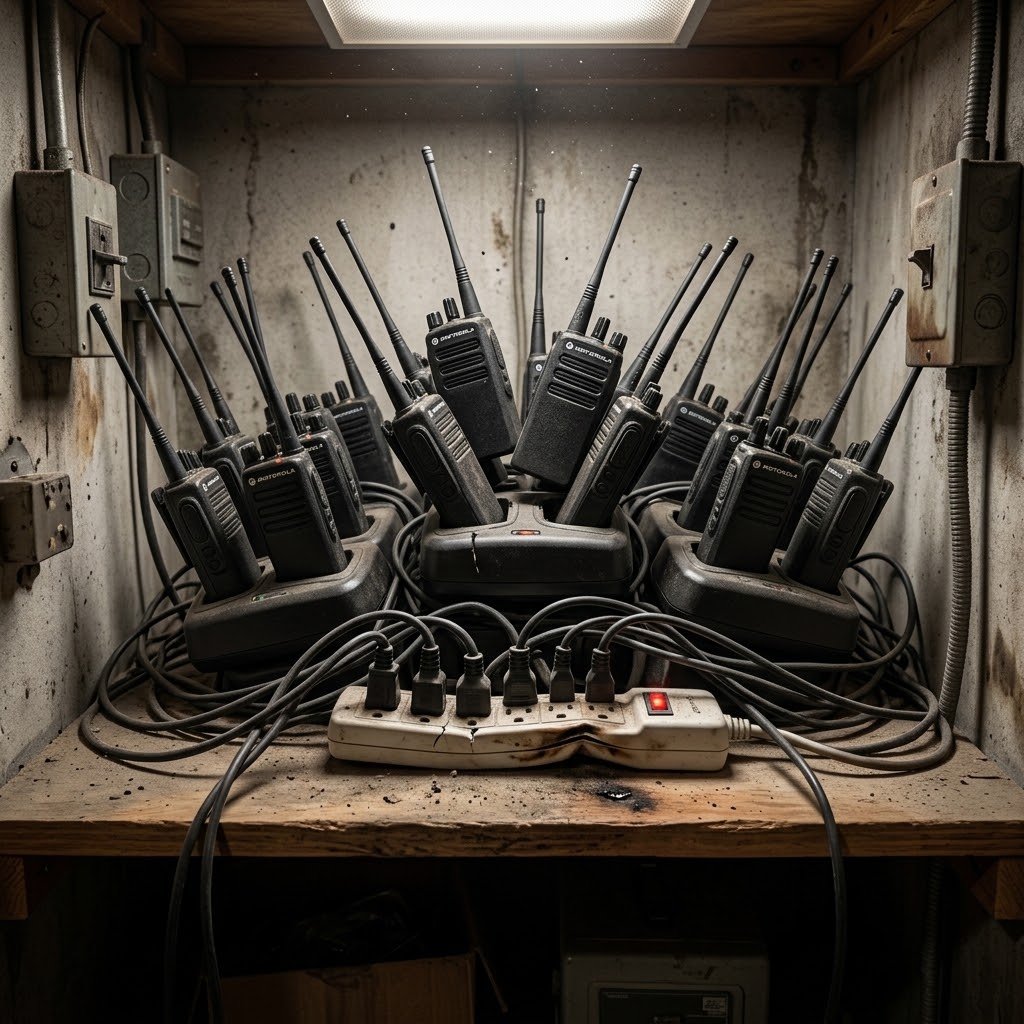
Across hundreds of commercial sites, a familiar and hazardous pattern emerges: multi-unit charger banks daisy-chained into low-cost power strips, crammed onto wooden shelves inside unventilated custodial closets or electrical rooms. This makeshift approach is a major operational liability. Poor thermal dissipation, undersized circuits, and combustible surroundings create severe fire hazards, accelerate battery degradation, and trigger frequent charger dock failures.
As facility management teams establish standardized maintenance protocols—such as tracking cell lifecycles across their fleet—they must also build a safe, code-compliant physical foundation for power distribution. Designing dedicated centralized charging rooms ensures hardware reliability, protects capital investments, and maintains compliance with national fire codes. Explore our full library of technical guides within our Facility Ops category to streamline your site’s physical infrastructure.
The Operational Hazards of Unplanned Charging Stations
When facilities scale up their radio fleets without upgrading electrical and room infrastructure, five primary failure vectors develop:
- Thermal Stress and Thermal Runaway: Multi-unit rapid chargers generate significant thermal output during initial bulk-charge cycles. When multiple 6-gang or 12-gang charging banks sit in enclosed spaces without adequate airflow, ambient room temperatures spike. High ambient heat combined with internal battery charging resistance dramatically increases the risk of thermal runaway in Lithium-Ion (Li-ion) cells.
- Off-Gassing Hazards in Mixed Fleets: While Li-ion is standard, many legacy and Intrinsically Safe (IS) enterprise fleets still utilize Nickel-Metal Hydride (NiMH) chemistries. Overcharging or rapid-charging damaged NiMH cells releases trace hydrogen gas, creating an explosive atmospheric hazard if forced ventilation is absent.
- Electrical Overloads and Nuisance Tripping: When an entire shift docks dead radios simultaneously, charging banks experience simultaneous peak bulk-charge draws. Plugging three or four multi-unit chargers into a single 15-amp branch circuit—often shared with existing lighting or custodial equipment—causes frequent circuit breaker trips, leaving oncoming shifts with uncharged equipment.
- Fire Code Non-Compliance: Storing and charging banks of batteries on flammable surfaces (such as unfinished wooden shelving) or within designated egress corridors directly violates National Fire Protection Association (NFPA) standards, including NFPA 1 (Fire Code) and NFPA 70 (National Electrical Code).
- Single Point of Failure During Grid Loss: Unplanned charging setups rarely account for emergency power integration. During utility grid failures or severe weather events, unbacked charging docks leave incident management teams stranded with dead battery inventory.
Evaluating Charging Station Locations
Selecting the correct space for centralized charging infrastructure dictates long-term safety, code compliance, and operational efficiency.
| Location | Operational Pros | Operational Cons & Safety Risks | Verdict |
| Custodial Closets & Utility Rooms | Out of sight; central to staff traffic paths | Extremely high fire risk; poor ventilation; chemical vapor exposure accelerates contact corrosion | Prohibited |
| Active Electrical Rooms | High power availability; restricted unauthorized access | Violates electrical clearance codes (NEC 110.26); high dust accumulation; restricted daily access | Non-Compliant |
| Open Office / Breakrooms | Highly accessible; climate controlled | High distraction; vulnerable to key theft, liquid spills, and unmonitored handset swapping | Not Recommended |
| Shared Dispatch / Security Hubs | 24/7 visual oversight; direct access for shift leads | Space constraints; elevated ambient noise from cooling fans; cable clutter | Conditional (Low-Density Fleets) |
| Dedicated Communications / Charging Room | Optimized HVAC; dedicated circuits; emergency backup integration; fire suppression; centralized control | Requires dedicated square footage and upfront capital allocation | Optimal / Best Practice |
1. Dedicated Electrical Allocation and Circuit Sizing
Never share charging circuits with general-purpose wall outlets or heavy machinery.
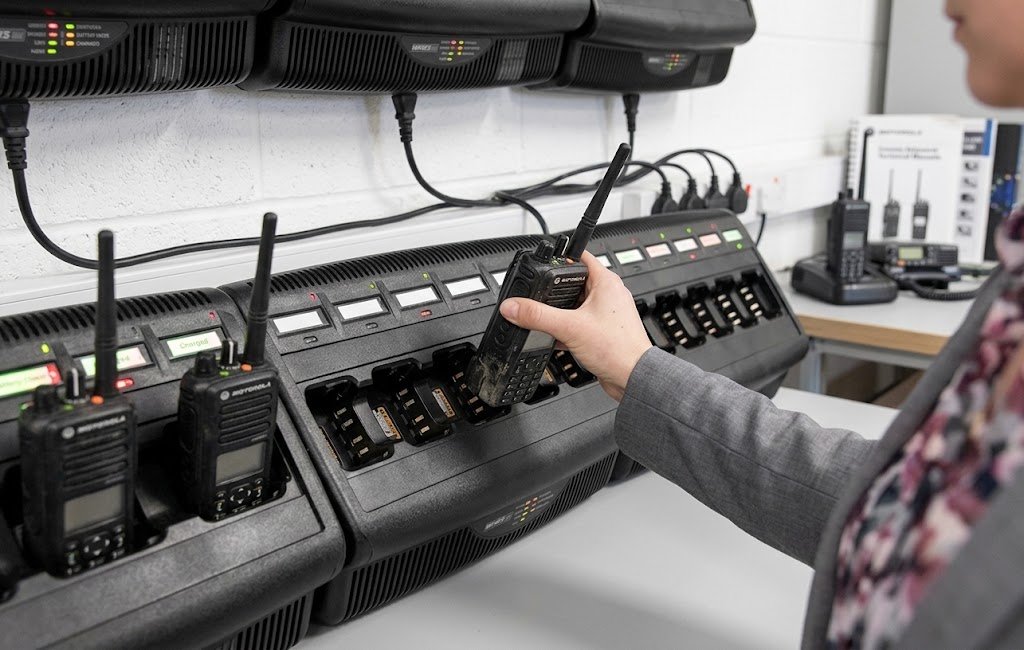
- Dedicated Branch Circuits: Install dedicated 20-amp, 120V branch circuits serving heavy-duty commercial outlets. To prevent accidental cable unplugging caused by high staff traffic, specify locking receptacles such as NEMA L5-20R twist-lock outlets for primary distribution feeds. Limit each 20-amp circuit to a maximum of three 6-bay multi-unit chargers to accommodate peak initial bulk-charge draws while maintaining the mandatory NEC 80% continuous load safety margin (16A maximum continuous draw).
- Hardwired Power Distribution Units (PDUs): Replace consumer power strips with rack-mounted or wall-mounted industrial PDUs featuring built-in circuit breakers, heavy-gauge (12 AWG) power cords, and integrated surge suppression rated for a minimum of 2,000 Joules.
- Ground Fault Protection: Ensure all outlets serving the charging zone feature Ground Fault Circuit Interrupter (GFCI) protection to eliminate shock hazards in environments subject to wet footwear or cleaning operations.
- Emergency Power Supply System (EPSS) Integration: Tie the charging room’s primary electrical subpanel directly into the facility’s emergency backup generator loop or install hardwired, rack-mount Uninterruptible Power Supply (UPS) units. This guarantees continuous power to charging docks during facility outage response.
2. Thermal Management and Forced Ventilation
Charging banks act as localized heat emitters. Active climate control is essential to maintain ambient room temperatures within the optimal battery charging window of 60°F to 77°F (15°C to 25°C).
- Air Exchange Rates: Maintain positive air circulation with a minimum of 6 to 8 Air Changes per Hour (ACH) in dedicated charging rooms. This dissipates concentrated thermal loads and safely vents hydrogen off-gassing associated with overcharged NiMH or damaged Li-ion cells.
- Convection Clearance: Mount charging docks on open steel or aluminum wire rack shelving to promote 360-degree passive convection. Maintain a minimum of 4 inches of open air space between individual charger banks and at least 6 inches of clearance from rear mounting walls.
3. Fire Safety and Containment Standards
High-density charging setups must incorporate strict physical containment and automated fire mitigation.
- Non-Combustible Backing Panels: Mount all charger banks, wall brackets, and power supplies to non-combustible metal panels, Unistrut channels, or AC-grade fire-rated (FR-S) plywood coated with intumescent fire-retardant paint. Never place chargers on bare wood, carpet, or cardboard.
- Clean-Agent Automated Fire Suppression: Room protection should utilize the facility’s automated fire sprinkler system backed by localized clean-agent fire suppression systems (such as FK-5-1-12 or inert gas systems). Clean agents extinguish fires rapidly without leaving corrosive, conductive residues on sensitive charger circuitry.
- Thermal Early-Warning Detection: Install optical smoke detectors alongside localized thermal imaging or off-gas detection sensors directly above charging racks to detect battery cell off-gassing and elevated temperatures before open flame occurs.
Standardizing Inventory Control and Traffic Flow
A compliant charging room must streamline shift handoffs while securing high-value assets.
- Shift-Change Ergonomics: Design internal room circulation to prevent bottlenecks during peak 15-minute shift handoffs. Maintain a minimum aisle width of 36 inches in front of all charging racks to comply with ADA and egress standards.
- Physical Access Control: Equip entry doors with electronic keypads or smart card readers. Access logging restricts unauthorized entry, eliminates unmonitored handset swapping, and holds department leads accountable for equipment handling.
- FIFO Staging Strips: Implement First-In, First-Out (FIFO) visual staging markers across charging bays. Workers should only retrieve radios displaying solid green “Fully Charged” LEDs from designated active zones, allowing freshly docked units time to undergo proper conditioning cycles without premature removal.
For additional integration strategies covering mobile assets, site hardware, and operational infrastructure, visit our dedicated communications archive.
Securing the Power Backbone of Field Operations
Centralized radio charging rooms are critical operational nodes that demand rigorous engineering, code compliance, and proactive thermal management. Transitioning from makeshift power strips in custodial closets to dedicated, fire-safe charging facilities eliminates life-safety risks, extends battery service life, and ensures field teams have reliable communications every time they hit the push-to-talk button.