

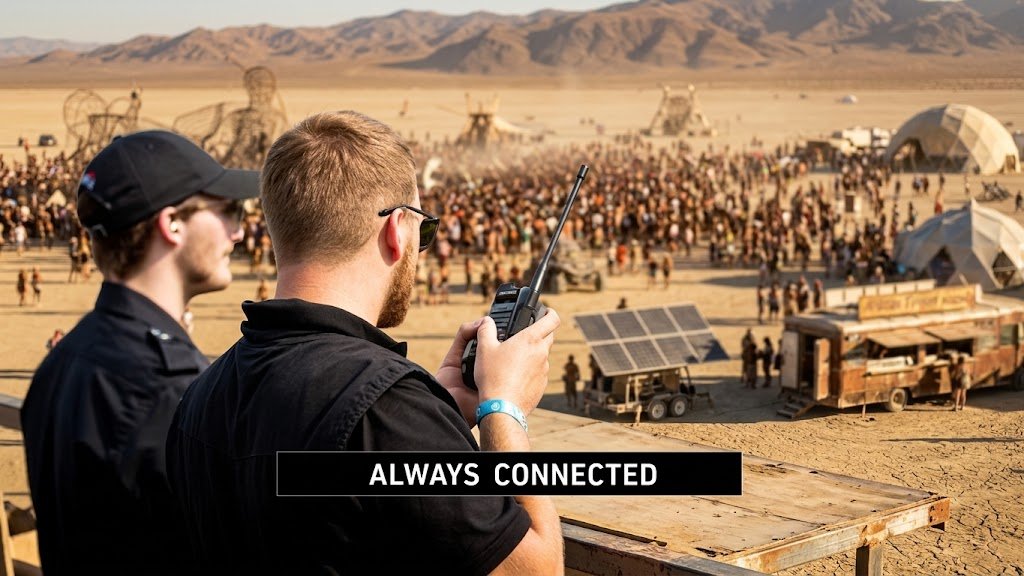
Festival communication demands an unprecedented level of operational reliability, especially when thousands of attendees gather in remote fields, expansive parks, or dense urban environments where standard infrastructure quickly fails. For site managers and operational directors, maintaining uninterrupted voice and data channels is not merely a matter of convenience—it is a critical safety requirement for crowd management, emergency response, and overall event logistics. When tens of thousands of personal smartphones flood local cellular towers, commercial networks collapse under the data load. Establishing a self-sustained, off-grid communications architecture ensures that safety leads, stage managers, security personnel, and medical teams remain fully connected, regardless of public network congestion.
The Core Operational Challenges of Off-Grid Event Sites
Managing large-scale festivals introduces complex environmental and physical variables that disrupt standard communication. Greenfield sites, such as farmland or desert plains, typically lack native telecom infrastructure altogether. Even when festivals take place in suburban or urban environments, heavy temporary infrastructure—including massive main stages, stacked shipping containers, food vendor rows, and perimeter fencing—creates substantial physical barriers that attenuate radio signals and create RF dead zones.
Furthermore, dynamic operational demands require distinct departments to coordinate seamlessly. Logistics teams moving heavy machinery during build-out need different access levels than security teams managing entry turnstiles or medical teams responding to incidents in the middle of a dense crowd. When a critical incident occurs, relying on consumer-grade mobile devices or unmanaged analog radios introduces latency, signal interference, and dangerous miscommunications. Operational leads must deploy a tiered, multi-technology communication plan that integrates dedicated local radio frequencies with modern digital networks.
Strategic Pillars of Modern Festival Communication Systems
Achieving flawless site coverage requires moving beyond basic point-to-point walkie-talkies. Modern festival infrastructures rely on a hybrid model that pairs time-tested digital land mobile radio (LMR) technology with contemporary broadband innovations. By combining local radio frequency (RF) networks with Push-to-Talk over Cellular (PTToC) and tactical repeaters, site directors can build an overlapping, redundant network matrix.
1. Push-to-Talk over Cellular (PTToC) Integration
Push-to-Talk over Cellular (PTToC) bridges the gap between traditional two-way radio functionality and high-speed broadband capability. PTToC allows team members to push a button on a ruggedized handheld device or smart radio and instantly communicate across dedicated talkgroups, leveraging private LTE networks or multi-carrier SIM cards.
For festival organizers, PTToC offers several distinct advantages:
Unlimited Geographic Range: Production staff travelling between off-site parking, local staging warehouses, and the main venue can communicate seamlessly with central dispatch without losing signal.
Rich Data Capabilities: Beyond push-to-talk voice, PTToC enables real-time GPS location tracking of key personnel, live video streaming from security checkpoints to central command, and automated alert dispatching.
Interoperability: PTToC systems can be patched directly into existing Digital Mobile Radio (DMR) channels via hardware gateways, allowing legacy two-way radio users to talk directly to smartphone- or PTToC-equipped personnel.
2. Deploying Portable Repeaters for Uncompromising Site Coverage
While PTToC provides expansive coverage and data integration, purely cloud- or cellular-dependent systems remain vulnerable if complete signal loss occurs. This is where high-performance portable repeaters become essential.
Portable repeaters serve as the backbone of true off-grid festival communication networks. These ruggedized, self-contained units receive low-power signals from handheld radios and retransmit them at higher power across broader distances, effectively penetrating stage scaffolding, heavy timber, and undulating terrain.
To maximize the effectiveness of portable repeaters across a festival site, consider the following deployment setups:
Elevated Positioning: Mount repeaters on existing high points, such as lighting towers, heavy-duty telescoping masts, or elevated site office structures, to maximize line-of-sight propagation.
Solar and Battery Autonomy: Use portable repeaters equipped with integrated lithium iron phosphate (LiFePO4) battery banks paired with portable solar arrays. This guarantees 24/7 continuous uptime throughout multi-day operations without demanding continuous generator power.
Tactical Mesh Repeaters: Modern digital repeaters can operate in a dynamic mesh configuration. If one repeater is physically damaged or obstructed, nearby units automatically reroute traffic through the remaining network nodes, maintaining coverage across the site.
Designing a Tiered Channel Architecture for Festival Fleets
Hardware is only half of the communication equation; network organization is equally vital. Placing every staff member on a single channel leads to total communication breakdown during high-volume periods or emergency scenarios. Operational directors must establish a clear, structured talkgroup hierarchy well before the first contractor steps foot on site.
| Channel Tier | Assigned Personnel | Primary Function | Priority Level |
| Tier 1: Emergency & Command | Operations Director, Security Lead, Medical Chief, Police/EMS Liaison | Incident Command, Life Safety, Tactical Escalation | High (Priority Override Enabled) |
| Tier 2: Tactical Operations | Zone Security Leads, Medical Response Teams, Crowd Control Teams | Field Incident Response, Perimeter Control | Medium-High |
| Tier 3: Site Logistics | Parking Marshals, Shuttle Drivers, Sanitation, Power/HVAC Techs | Site Maintenance, Traffic Flow, Refueling | Medium |
| Tier 4: Production & Stage | Stage Managers, Audio/Lighting Crew, Talent Escorts | Artist Movements, Show Timing, Stage Operations | Standard |
Essential Network Features for Site Directors
Priority Interrupt: Ensures that high-ranking operational leads can clear an active channel instantly during an emergency to broadcast critical instructions.
Geofenced Talkgroups: Automatically switches user radios or PTToC devices to local channel bands based on their physical coordinates within the festival grounds (e.g., automatically tuning security to “Camping West” upon entering that sector).
* Lone Worker and Man-Down Alerts: Integrated accelerometer features within handheld units automatically trigger emergency alerts at central dispatch if a staff member falls or remains motionless, providing precise GPS coordinates for rapid assistance.
Pre-Event Planning and Field Execution Best Practices
To ensure complete network integrity throughout the event lifecycle, site managers should execute a systematic deployment checklist leading up to doors-open.
1. Conduct an Early RF Spectrum Survey: Prior to installing infrastructure, perform a comprehensive spectrum analysis across the festival site to identify existing interference from local broadcast towers, neighboring industrial sites, or private radio networks. Sometimes information regarding dead zones or advantageous placements may have been brought up from a venue security debrief from previous years.
2. Stress-Test Repeaters Under Simulated Load: Do not wait for peak festival hours to evaluate signal capacity. Perform physical walk-tests during stage soundchecks when high-voltage equipment, video walls, and heavy lighting rigs are operating at full power, as these generate significant electromagnetic interference.
3. Implement Strict Battery Management Protocols: Establish a centralized radio management hub near command central. Implement a strict “one-for-one” swap policy for smart radio batteries, ensuring that field crews receive fresh, fully conditioned batteries at the start of every shift.
4. Train Non-Technical Personnel: Provide simple, mandatory briefing sessions for all radio holders. Staff should understand radio etiquette, standard phonetic call-signs, how to use emergency distress buttons, and the importance of keeping non-essential chatter off command channels.
By integrating robust portable repeaters with flexible PTToC systems, festival organizers and site managers can construct a flexible, redundant off-grid network capable of handling any operational challenge. Investing in reliable communications infrastructure minimizes downtime, accelerates emergency response times, and ensures a safe, smoothly executed event from site build to final egress.