

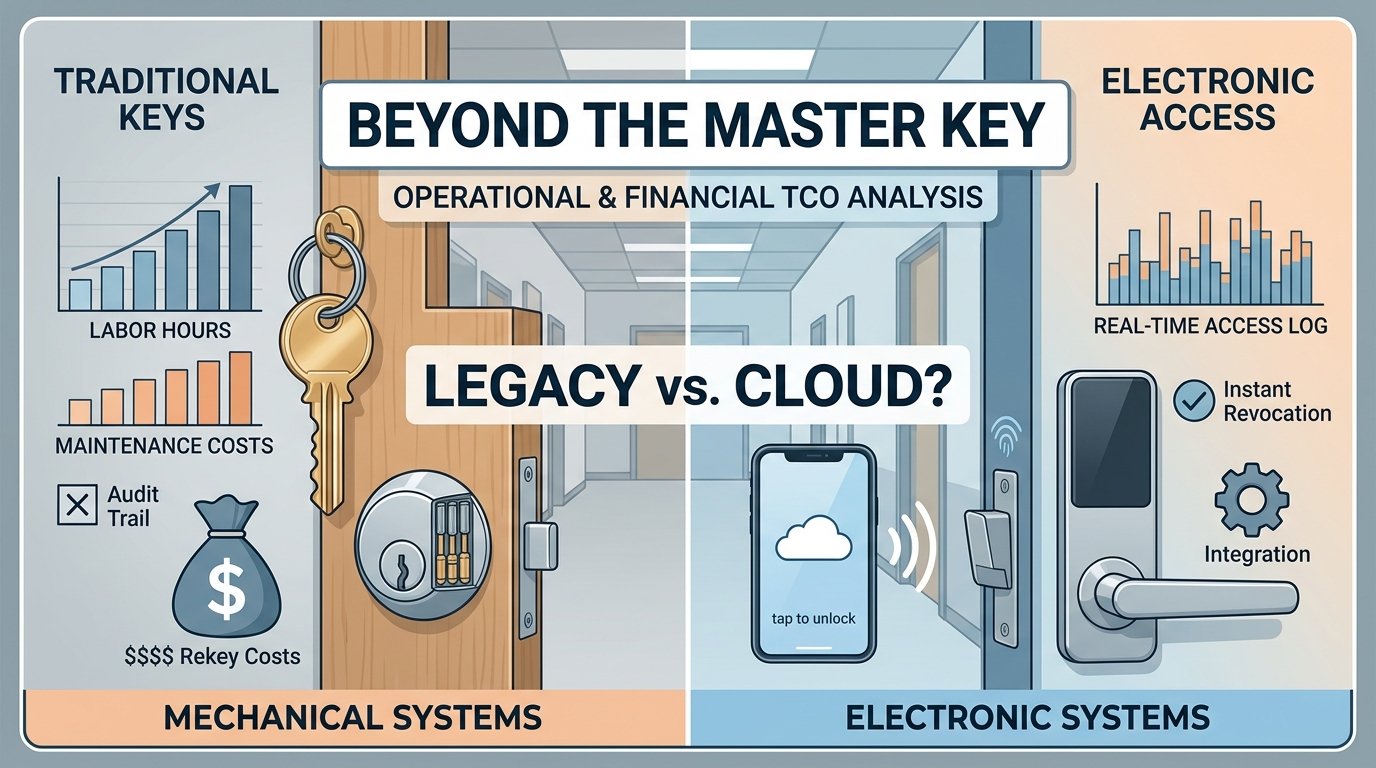
Traditional grand master key (GMK) systems present a fundamental structural paradox for higher education facilities leadership: they are cheap to acquire upfront, yet astronomically expensive to maintain over time. As campuses expand, personnel shift, and security threats evolve, mechanical pin-tumbler systems create hidden operational friction and severe financial liabilities that rarely appear on standard annual budget line items.
A comprehensive Total Cost of Ownership (TCO) analysis reveals that the true cost of legacy brass keys lies not in the physical keys themselves, but in the recurring operational burden of rekeying, labor overhead, administrative loss, and unmitigated exposure to physical security compromises.
Mechanical Keying vs. Cloud Credentialing TCO
| Cost & Risk Vector | Legacy Grand Master System | Cloud-Managed Access Control |
| Initial Deployment | Low hardware cost; minimal electrical infrastructure | High initial capital expenditure (controllers, readers, locks) |
| Compromise Remediation | $15,000–$80,000+ per GMK loss (hardware + labor) | $0 hardware cost; instant credential revocation via dashboard |
| Key/Credential Lifecycle | Manual cutting, stamping, key box logging, and hand-offs | Automated provisioning via SIS/HR integration (mobile or smartcard) |
| Audit & Visibility | Non-existent; relies on manual physical sign-out logs | Real-time event logs, entry attempt tracking, and door-state monitoring |
| Lockdown Execution | Manual physical perimeter traversal (30–90+ minutes) | Instant, global or zone-specific automated lockdown (< 5 seconds) |
| Labor Allocation | High; locksmiths dedicated to core swapping and cutting | Low; IT/Facilities manage permissions remotely in single-pane interface |
The Hidden Math Behind Master Key Vulnerabilities
When a higher education institution loses a grand master key, the direct and indirect expenses compound rapidly across multiple operational silos.
- Direct Core Replacement: A typical university building contains between 150 and 600 locked openings. Replacing interchangeable cores (SFIC/LFIC) averages $35 to $75 per core for hardware alone.
- Locksmith Labor Overhead: Unplanned core replacement demands emergency overtime or diverts locksmith staff from preventive maintenance. Swapping cores, re-stamping keys, and distributing replacement sets requires 1.5 to 2.5 labor hours per door.
- Administrative Administration: Verification of affected key holders, manual re-issuance, signature collection, and audit updates consume hundreds of administrative hours across campus housing, academic departments, and public safety.
- Liability and Insurance Exposure: Carrying unmonitored master key access across residence halls or high-value research labs increases insurance premiums and exposes institutions to massive negligence liability during security incidents.
For a mid-sized university experiencing just one major GMK compromise every three years, the direct 10-year mechanical TCO routinely exceeds $250,000—a figure that equals or surpasses the amortized capital investment of upgrading to an electronic access control (EAC) platform.
Operational Checklist: Evaluating Migration Readiness
Before transitioning from brass to electronic credentials, facilities teams must assess existing infrastructure to streamline deployment and optimize long-term return on investment:
- Door Hardware Audit: Inspect existing door prep, ANSI strikes, and mortise pockets to determine if wireless/offline electronic locks can retrofit directly without door replacement.
- Network & Power Topology: Determine whether perimeter and high-density interior openings should utilize Power over Ethernet (PoE), hardwired RS-485 controllers, or wireless (Wi-Fi/Zigbee) locksets.
- Identity Provider (IdP) Integration: Verify that the cloud platform natively syncs with higher education systems (e.g., Active Directory, Canvas, Banner, Workday) for automated onboarding and offboarding.
- Mobile Credential Compatibility: Assess student body device usage (NFC/BLE on Apple Wallet and Android) to eliminate physical smartcard replacement costs entirely.
- Emergency Response Protocols: Ensure the software platform supports one-touch hardware integration with campus public safety dispatch (CAD systems) for immediate lockdown capability.
Operational Tip: The Phased “Outside-In” Migration Strategy
Field Recommendation: Do not attempt a single-phase, campus-wide hardware overhaul. Execute a phased migration starting with building perimeters and high-liability zones (research facilities, server rooms, and residential commons).
Deploying offline or wireless electronic locks on interior office doors allows institutions to use existing lock preps while immediately eliminating the top-level grand master key from circulation. This shrinks the mechanical attack surface by over 80% within the first deployment phase while keeping capital expenditure manageable across fiscal years.
Transitioning from Liability to Operational Efficiency
Continuing to rely on legacy grand master key systems is an operational gamble that guarantees escalating labor costs and severe security risk. While mechanical hardware appears cost-effective on initial purchase orders, its long-term Total Cost of Ownership imposes a tax on university operations through emergency rekeying, manual administration, and vulnerability to loss.
Transitioning to a cloud-managed electronic credentialing architecture replaces unmonitored physical liabilities with real-time auditability, automated lifecycle management, and instant remediation. Facilities leadership that proactively shifts from brass to cloud infrastructure transforms campus security from an unpredictable cost center into a resilient, scalable operational asset.
One thought on “Beyond the Master Key: The Total Cost of Ownership of Legacy Mechanical Key Infrastructure”