

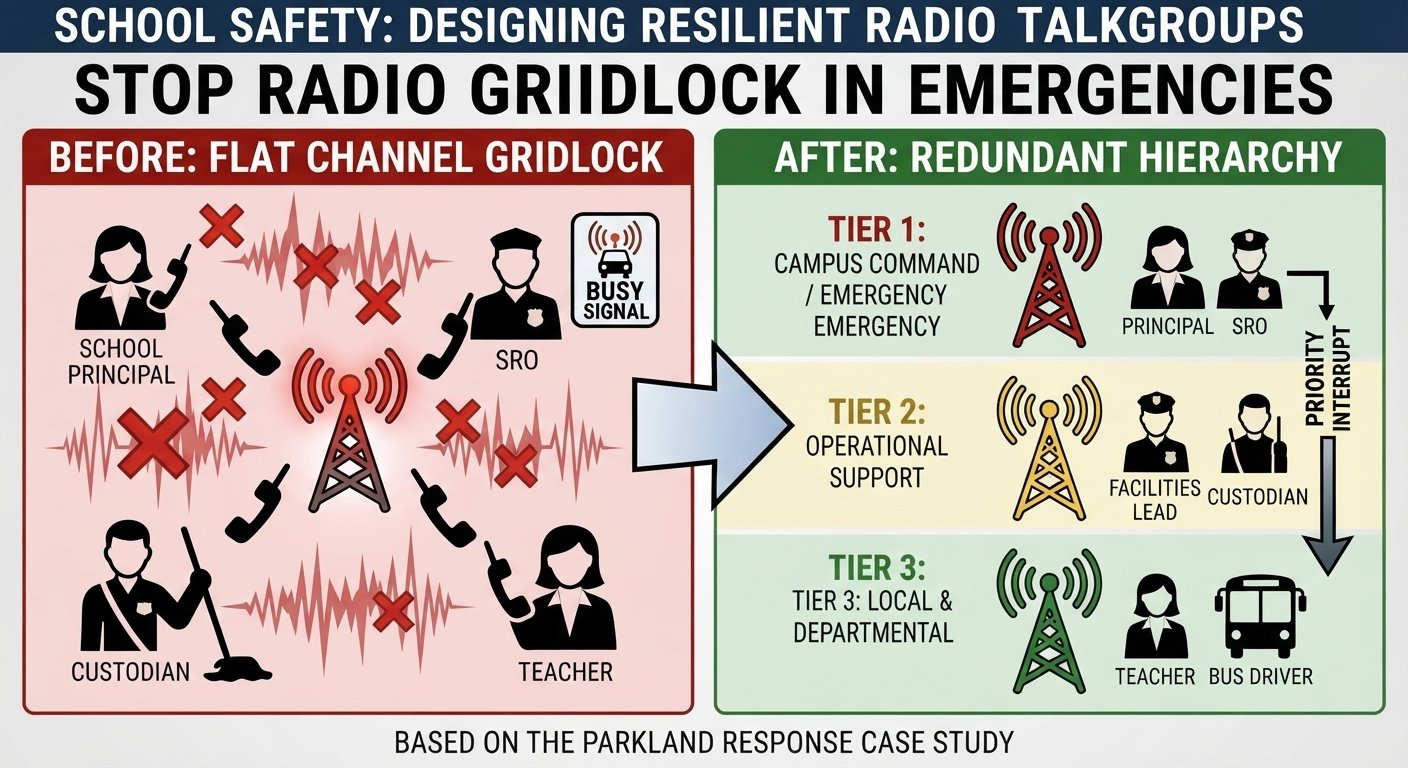
When an emergency occurs at a school campus, administrators, building engineers, campus monitors, and local School Resource Officers (SROs) naturally grab their handsets. Without a structured command channel hierarchy plan, every user turns to the primary operational channel. The result is instant RF congestion: stepped-on transmissions, garbled audio, and critical panic alerts blocked by routine facilities updates.
Having hardware that passed a thorough pre-term inspection—like the checks outlined in our Back-to-School Radio Audit Guide—is only half the battle. If your channel plan is a single unorganized channel, your operational infrastructure will collapse when seconds matter most.
Designing a resilient talkgroup architecture with redundant Incident Command System (ICS) channels prevents operational gridlock and ensures clear, uninhibited school and campus safety communications.
Case Study: How System Throttling Hampered the Parkland Response
The fatal breakdown of voice communications during the 2018 tragedy at Marjory Stoneman Douglas High School in Parkland, Florida, serves as a sobering example of radio system throttling.
As dozens of law enforcement officers, administrators, and first responders converged on the campus, hundreds of personnel attempted to key up on the same primary talkgroups simultaneously. The sudden spike in uncoordinated traffic instantly overloaded the regional trunked radio network.
Because the system lacked automated prioritization and a structured channel offloading protocol, the infrastructure throttled:
- The “Busy Signal” Lockout: Responding deputies attempting to transmit life-saving intelligence were met with repeated system denial tones (a continuous “bonk-bonk-bonk” sound).
- Dropped Transmissions: More than 500 individual radio transmissions were completely dropped or unreceived due to signal collisions.
- Command Paralysis: Field units could not relay the suspect’s movement, and incident commanders were repeatedly blocked from delivering tactical instructions because rank-and-file transmissions choked the pipe.
Parkland demonstrated that hardware availability means nothing without strict channel segregation. Without a tiered talkgroup architecture, emergency traffic will default to a single pipe, causing system-wide throttling that cripples the effectiveness of your entire response team.
The Operational Risk of a Flat Channel Setup
In day-to-day operations, housing all staff on one or two channels seems convenient. However, during an active threat, severe weather event, or major medical emergency, a flat talkgroup structure creates three severe failure points:
- Stepped-On Transmissions: Digital and analog radios cannot process simultaneous signals on the same frequency. When two users key up at once, the transmissions collide, resulting in dead air or unintelligible noise.
- Information Overload: First responders and administrators get bogged down listening to tactical facilities updates (e.g., turning off air handlers or unlocking exterior gates) when they only need critical threat intelligence.
- Lack of Redundancy: If an incident compromises the primary channel—or if a user unintentionally holds down their push-to-talk (PTT) button (a “hot mic”)—the entire campus loses voice communications.
Campus Incident Command Channel Hierarchy
A battle-tested talkgroup structure relies on clear operational separation. Handsets across campus should be programmed to follow a strict vertical hierarchy, separating daily operational noise from emergency command operations:
[ Tier 1: Campus Command / Emergency ]  <── Restricted Access
  │
  ├── Talkgroup A1: TAC-1 / Primary Incident Command (SROs, Admin, Lead Security)
  ├── Talkgroup A2: TAC-2 / Redundant Command (Backup & First Responder Patch)
  └── Talkgroup A3: Campus Lockdown / Broadcast Only (All-Call Emergency Override)
        │
        ▼
[ Tier 2: Operational Support Tiers ]    <── Standard Daily Access
  │
  ├── Talkgroup B1: Facilities, Engineering & Electrical
  ├── Talkgroup B2: Custodial Services & Event Logistics
  └── Talkgroup B3: Transport, Bus Operations & Traffic Control
        │
        ▼
[ Tier 3: Departmental & Local ]        <── Site-Specific
  │
  └── Talkgroup C1-C4: Individual Building Operations / Field Trip Logistics
Structuring Primary, Secondary, and Tertiary Command Channels
To maintain order during an event, your radio fleet’s Zone 1 (or primary channel bank) should reserve dedicated, standardized channels for emergency management.
1. Primary Incident Command (TAC-1 / Command) This channel is strictly reserved for the Incident Commander (usually the principal or district safety director), lead campus security officers, and the primary SRO. During an active incident, all routine chatter on TAC-1 stops. This channel is used exclusively to direct response actions, communicate with incoming public safety dispatch, and make strategic decisions.
2. Redundant Tactical Command (TAC-2 / Operations) If TAC-1 experiences a hot-mic event, heavy RF interference, or gets overcrowded during a multi-agency response, the Incident Commander issues a clear directive: “All units, move to TAC-2.” TAC-2 serves as an immediate, pre-programmed failover channel. It can also be dedicated to tactical field movements—such as staging area coordination or perimeter containment—without cluttering the main command frequency.
3. Interoperability & First Responder Patch (TAC-3 / Mutual Aid) Most school radios operate on commercial VHF/UHF bands or local P25 trunked networks. TAC-3 should be set up as an interoperability channel, patched directly into local police, fire, and EMS radio networks via gateway hardware or pre-coordinated mutual aid frequencies. This allows local police captains arriving on scene to speak directly with campus security leadership without handing off physical radios.
Isolating Facilities Chatter from Emergency Operations
Facilities technicians and custodial staff play a vital role during an emergency—executing remote lockdowns, providing floor plans, shutting down HVAC systems, and controlling utility shut-offs. However, their operational coordination must happen on dedicated channels.
- Automated Priority Interrupt: Modern digital radios (DMR and P25) feature a “Priority Interrupt” function. System administrators can program security and admin radios with high-priority status. If a custodian is speaking on a secondary channel, a security officer can press PTT to immediately clear the channel for an urgent safety alert.
- The “Clear Tone” Protocol: When an emergency is declared, dispatch or administration sends a distinct two-tone alert signal across all operational talkgroups (Facilities, Custodial, Transport). This signals non-security personnel to hold all non-essential radio traffic and switch to listen-only status.
- Designated Liaison Roles: Instead of every facilities worker switching to TAC-1, assign a single Facilities Liaison (typically the Director of Physical Plant) to monitor both the Facilities channel (B1) and TAC-1. They gather updates from their field team and relay condensed operational intel to the Incident Commander.
Standardizing Cross-Departmental Radio Protocols
A robust channel architecture is only as effective as the training behind it. School districts must establish clear, mandatory plain-language radio protocols across all departments.
- Eliminate Ambiguous Codes: Avoid using 10-codes or local jargon (e.g., “Code Blue” or “10-33”), which vary between school staff and outside emergency agencies. Enforce clear, plain-language statements (e.g., “Medical Emergency, Main Gym” or “Lockdown, East Wing”).
- Enforce the “Hey-You, It’s-Me” Format: Require staff to state the recipient’s identifier first, followed by their own (e.g., “Command, this is Custodial Lead”). This ensures the intended party is listening before critical information is transmitted.
- Mandatory Annual Radio Drills: Incorporate talkgroup switching into routine fire, weather, and lockdown drills. Require teachers, custodians, and administrators to practice switching from their daily operational channel to TAC-1 and TAC-2 under timed conditions.
Building a Resilient School Safety Infrastructure
Properly configured radio channels transform a chaotic, noisy environment into a structured command network. By separating daily facility operations from high-stakes incident management, creating redundant command talkgroups, and enforcing strict plain-language communication rules, school districts ensure that vital information gets through without delay when crisis strikes.
To learn more about optimizing physical assets and campus operations, explore our Facility Ops Category. For broader strategies on managing K-12 and higher education infrastructure, visit our dedicated Education Topic Center.