

Selecting an enterprise wireless communication system is one of the most consequential infrastructure decisions a facility or operations director can make. A well-designed communications backbone functions seamlessly in the background, driving operational efficiency, staff safety, and rapid emergency response. Conversely, an ill-fitted system leads to dangerous coverage blind spots, daily operational friction, wasted capital expenditure, and potential regulatory non-compliance during life-safety events.
With modern communication technologies spanning traditional two-way Land Mobile Radios (LMR), wide-area digital trunking, Push-to-Talk over Cellular (PoC), and hybrid networks, identifying the ideal setup requires evaluating specific operational variables rather than relying on vendor brand loyalty.
Part 1: The Nine Core Operational Criteria
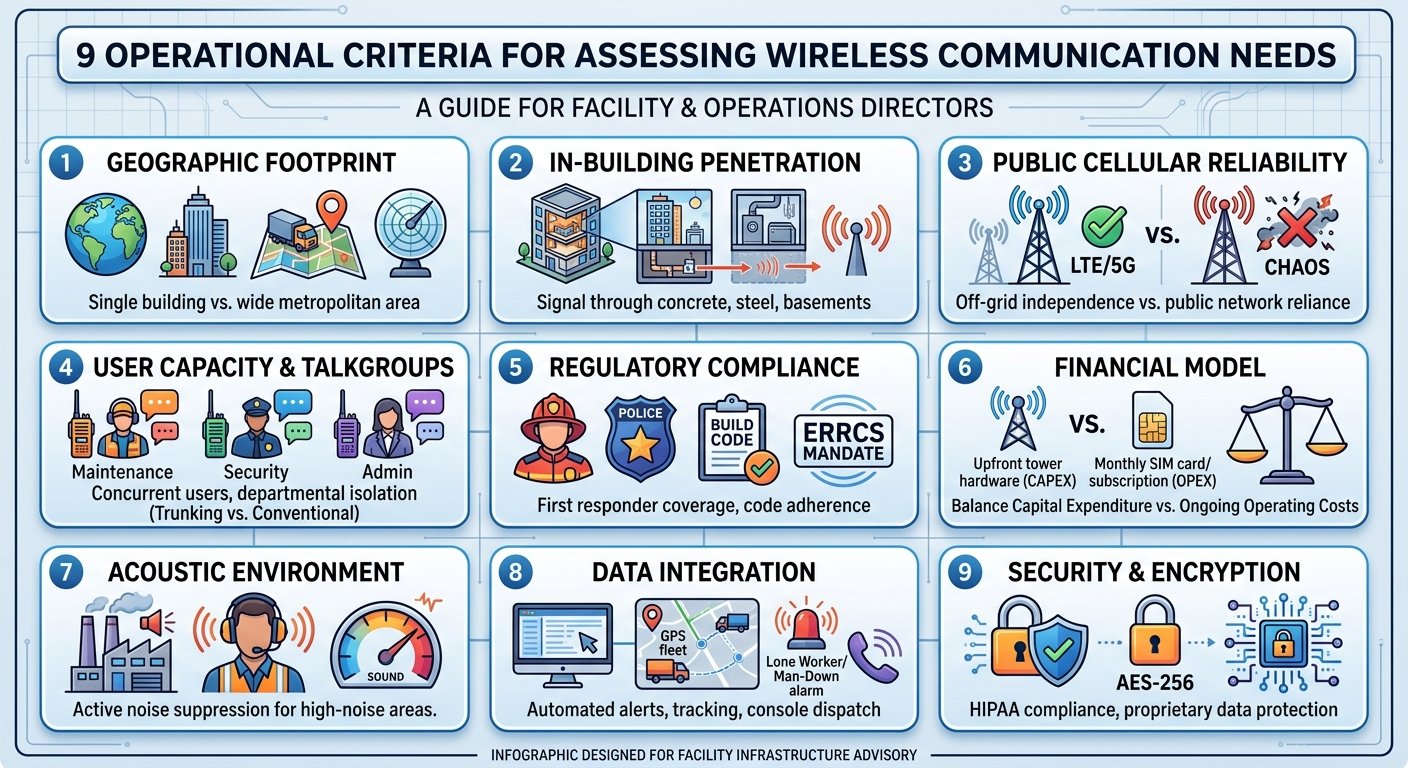
Before reviewing hardware specifications or evaluating product brochures, operations directors must systematically audit their organization across nine core technical and operational dimensions:
1. Geographic Footprint & Operating Topography
Are your teams operating within a single physical footprint (e.g., a K-12 school building), across an expanse (e.g., a university campus or resort), or throughout a metropolitan wide area (e.g., fleet delivery or municipal transit)? Topography also plays a vital role: high-density urban environments with heavy concrete and steel reflect and attenuate radio signals, whereas rural terrains demand low-frequency propagation (such as VHF) to bend over hills and cut through heavy foliage.
2. In-Building Penetration & Sub-Grade Structures
Heavy commercial construction materials—reinforced concrete, low-E energy-efficient glass, and below-grade basements—act as radio frequency (RF) shields. If personnel must communicate from underground parking garages, mechanical vaults, or shielded medical suites, standard handheld portables operating on direct line-of-sight will fail without specialized indoor signal amplification.
3. Public Cellular Reliability & Off-Grid Independence
Determine whether your operations can tolerate commercial network downtime. Push-to-Talk over Cellular (PoC) leverages existing 4G/5G and Wi-Fi networks, eliminating the need for expensive private tower infrastructure. However, during natural disasters, extreme weather, major civic events, or power outages, commercial cellular towers frequently experience heavy network congestion or failure. Operations requiring guaranteed, mission-critical uptime must maintain independent, private Land Mobile Radio (LMR) infrastructure.
4. User Capacity & Talkgroup Architecture
Quantify your peak active user base and department segregation needs. If three distinct teams (e.g., Maintenance, Security, Administration) operate independently, simple conventional channels suffice. However, when dozens of specialized teams (e.g., ground handling, baggage, catering, security, gate agents) require isolated channels, static frequency assignment causes severe spectrum bottlenecks. Large operations require trunking—a computer-managed system that dynamically allocates a shared pool of frequencies on demand.
5. Regulatory Code & First Responder Interoperability
In many jurisdictions, local municipal building codes mandate that facility owners guarantee Emergency Responder Radio Coverage Systems (ERRCS) inside their structures so first responders maintain radio contact during an emergency. Furthermore, operations like private security contractors or ambulance fleets must evaluate whether their radios need direct interoperability with municipal public safety agencies on P25 or TETRA bands.
6. Financial Model: CAPEX vs. OPEX Balance
Private LMR systems represent a high upfront Capital Expenditure (CAPEX) for towers, repeaters, antennas, and spectrum licensing (FCC or ISED Canada), but carry minimal ongoing operational costs. PoC and cellular-hybrid systems dramatically reduce initial CAPEX but introduce recurring monthly service subscription fees per user (Operating Expenditure – OPEX).
7. Acoustic Noise & Physical Ergonomics
High-noise industrial environments (e.g., railyards, manufacturing plants, tarmac operations) render standard handheld speakers unusable. These environments require specialized heavy-duty hardware equipped with dual-microphone active noise suppression and industrial noise-canceling headsets. Additionally, physical safety features like Lone Worker response timers and Man-Down tilt sensors are essential for hazardous or isolated work environments.
8. Data Integration & Dispatch Capability
Modern communications extend beyond voice connectivity. Operational teams often require automated voice alerts triggered by building management systems (BMS), real-time GPS fleet mapping, lone-worker duress tracking, or integration with telephone PBX networks to dial external landlines directly from hand-held radios.
9. Security & Privacy Requirements
Commercial operations discussing general logistics can rely on standard digital radio scrambling. However, healthcare facilities subject to patient privacy laws (HIPAA), financial couriers, or high-level private security operators require hardware-based AES-256 encryption to prevent eavesdropping and signal interception.
Part 2: Strategic System Decision Framework
System Architecture Selection Summary
| System Architecture | Ideal Operational Profile | Key Advantages | Primary Constraints |
| Direct Mode / Simplex | Small single-site teams, short range (e.g., small event staff, retail). | Zero infrastructure costs; works completely off-grid. | Extremely limited range (1–2 miles max); poor building penetration. |
| Conventional Digital Repeater | Single facilities, K-12 schools, small resorts, manufacturing plants. | Moderate cost; excellent local building coverage; clear digital audio. | Limited channel capacity; non-dynamic channel allocation. |
| Trunked Digital LMR (DMR Tier III) | Large campuses, airports, heavy fulfillment centers, seaports. | Maximum channel efficiency; supports thousands of users; priority queueing. | High initial CAPEX for controllers and multi-channel RF hardware. |
| Push-to-Talk over Cellular (PoC) | Metropolitan service fleets, plumbing, long-haul trucking, city logistics. | Unlimited nationwide range; low upfront cost; built-in GPS mapping. | Requires commercial network uptime; recurring monthly SIM/data fees. |
| In-Building DAS / ERRCS | Hospitals, high-rises, subterranean facilities, emergency compliance. | Eliminates indoor RF dead zones; satisfies municipal life-safety codes. | Requires specialized installation, cabling, and RF engineering. |
Key Takeaway for Operations Leadership
Before committing capital, conduct a professional RF propagation survey and site audit. Testing real-world coverage within your facility’s worst-case signal environments (e.g., elevator shafts, basements, heavily shielded mechanical rooms) ensures that your selected system delivers safe, dependable communications when it matters most.