

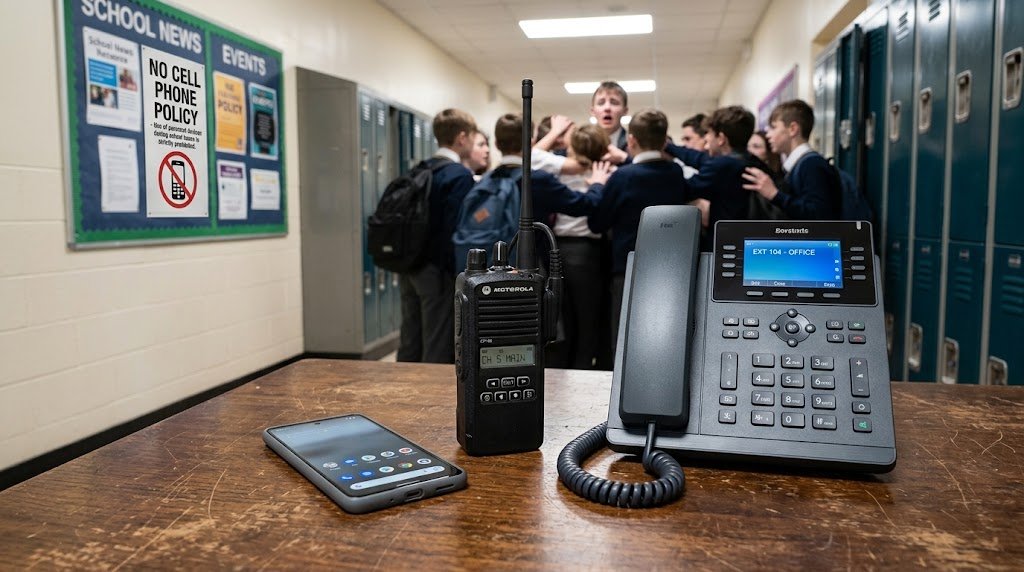
Across K-12 districts and higher education institutions, administrators are swiftly passing phone-free campus mandates to remove digital distractions from the classroom. While these policies effectively reset academic focus, they frequently trigger an unforeseen operational crisis: the immediate loss of primary communication channels for non-teaching facilities and support staff.
When schools restrict or discourage personal smartphone usage across campus grounds, custodians, maintenance technicians, groundskeepers, bus drivers, and yard supervisors lose the ad-hoc cellular connections they rely on to manage daily logistics and urgent incidents. Relying on personal smartphones was always a stopgap security compromise—much like legacy mechanical key setups that lack central oversight. Just as institutions are evaluating modern access controls over outdated keying systems in our Master Key TCO Analysis, campus operations teams must re-architect physical communication infrastructure to support a mobile, phone-free workforce.
The two most common methods of communication among staff are the use of Two-way radio equipment and dedicated VoIP handsets in classrooms. Each of the alternative setups have its own advantages and drawbacks from cost to blind spots.
Comparing Staff Operational Communication Channels
| Operational Vector | Cellular / Personal Smartphones for Staff Only | Commercial Two-Way Radio (Push-to-Talk) | Dedicated VoIP Handsets |
| Policy Compliance | Conflicts with phone-free rules; high policy friction when only staff can use cell phones | Fully compliant; non-distracting tool | Compliant; limited to indoor Wi-Fi zones |
| Operational Readiness | Poor; delayed dialing, dead zones, dead batteries | Immediate (< 1 sec call setup); ruggedized | Moderate; dependent on Wi-Fi roaming handoffs |
| Field Durability | Low IP rating; screen break risk in field work | High (MIL-STD-810G, IP67 dust/waterproof) | Moderate; fragile drop ratings |
| Hands-Free Capability | Low; requires pulling device from pocket | High; heavy-duty shoulder mics / earpieces | Low-to-Moderate; speakerphone or headset |
| Coverage Scope | Variable; sub-grade and interior dead zones | Complete; amplified via local repeaters/DAS | Limited; strictly tied to indoor access |
Role-Specific Hardware and Accessory Matrix
As an education implements alternative internal communication system, the institution must also be aware that there is no such thing as a one-size-fits-all hardware rollout. Different staff roles may have different equipment needs when it comes to their communication equipment. Not heeding the need may result in either equipping the staff with an incompatible communication equipment or overspending on features not needed. Some role based considerations include:
- Custodial & Maintenance Teams: Require IP67-rated water- and dust-resistant PTT radios paired with heavy-duty remote speaker microphones (RSMs). RSMs clip securely to shoulder straps, allowing workers handling equipment or chemical solutions to communicate without taking hands off their work.
- Yard Supervisors & Campus Monitors: Require discreet, lightweight acoustic tube earpieces or push-to-talk headsets. This allows staff to receive critical safety alerts clearly over outdoor crowd noise while keeping communications private from nearby students.
- Bus Drivers & Transit Logistics: Require fixed mobile radios mounted inside vehicles with external roof antennas. Units should feature clear channel-selector knobs and noise-canceling palm microphones to maintain clear dispatch linkup during loud drop-off cycles.
Operational Checklist: Eliminating Non-Classroom Dead Zones
Eliminating cellular dependency requires guaranteeing 100% Radio Frequency (RF) coverage across non-classroom spaces where incidents often originate. Facilities teams must systematically audit and harden these high-risk areas:
- Basements and Mechanical Rooms: Test RF penetration through reinforced concrete, boiler rooms, and sub-grade utility vaults.
- Athletic Fields and Perimeter Facilities: Map signal strength along outer fence lines, bleachers, parking lots, and stadium press boxes.
- Auxiliary Buildings & Storage Structures: Ensure continuous connectivity inside metal maintenance sheds, detached garages, and outdoor concession stands.
- Stairwells and Elevator Shafts: Verify that emergency transmissions maintain integrity within enclosed concrete exit corridors during campus sweeps.
- Distributed Antenna System (DAS) Integration: Where structural shielding blocks radio signals, deploy bi-directional amplifiers (BDAs) to eliminate structural dead zones.
Operational Tip: Implementing Structured Channel Hierarchy
Field Recommendation: Never consolidate all campus staff onto a single shared talk channel. High chatter creates signal fatigue, leading staff to turn down volume knobs or miss critical transmissions.
Structure your channel plan into dedicated functional zones (e.g., Channel 1: Facilities & Grounds, Channel 2: Custodial & Event Prep, Channel 3: Campus Safety & Admin). Implement a hardware-enforced “All-Call” override feature on dispatch and lead radios so facility directors and administrators can instantly commandeer all channels during critical emergency situations.
Building a Resilient Campus Operational Backbone
Enforcing phone-free student mandates is a positive step toward reclaiming educational focus, but it cannot come at the expense of staff safety and operational coordination. By replacing ad-hoc cellular habits with structured channel plans, rugged role-specific accessories, and robust RF coverage, facilities leaders ensure their field teams remain fully connected, responsive, and secure.
Explore more tactical strategies for managing campus infrastructure in our Facility Ops section, or browse our latest insights on modern learning environments in the Education Topic Center.
One thought on “Phone-Free Campus Mandates: Bridging Staff Communication Gaps Beyond Cellular Reliance”