

In enterprise facility operations, silence is rarely golden. When a lead HVAC technician loses power in a subterranean boiler room, or a security officer’s handset cuts out mid-response during an unauthorized access attempt, the root cause is almost never a dead repeater or broken antenna. It is a degraded, end-of-life radio battery that collapsed under load due to a poor two-way radio battery management system.
Most facility operations run two-way radio batteries well past their functional lifespan. Because a green light on a desktop charger indicates charging completion, facilities teams assume the battery is operational. In reality, aging cells suffer severe duty-cycle decay: they hold enough voltage to power an idle receiver, but the moment a worker presses the push-to-talk (PTT) button—demanding a heavy current draw—the cell suffers a steep, silent voltage drop.
Treating radio batteries as disposable, run-it-until-it-dies consumables introduces severe operational risk. Implementing a structured Radio Battery Management protocol transforms power infrastructure from an unpredictable liability into a reliable, proactive system.
Understanding Battery Chemistry and Duty-Cycle Decay
To manage battery lifecycles effectively, facilities managers must understand how industrial batteries degrade over time. Modern enterprise two-way radios rely primarily on Lithium-Ion (Li-ion) chemistry, alongside legacy Nickel-Metal Hydride (NiMH) units still fielded in heavy industrial settings.
Land mobile radio (LMR) capacity planning relies on the industry-standard 5-5-90 duty cycle:
- 5% Transmission Time: High power drain (4–6 Amps) when pressing PTT.
- 5% Receive Time: Moderate power drain (100–300 mA) when receiving audio.
- 90% Standby Time: Low background power drain (20–50 mA) while monitoring channels.
As a battery ages, its internal resistance increases. A new 2,200 mAh Li-ion battery easily provides 12 to 14 hours of continuous operation under a standard 5-5-90 load. However, after 18 to 24 months of daily charge-discharge cycles, internal chemical degradation reduces actual usable capacity by 20% to 40%. The battery may still display “full” status off the charger, but its operational window shrinks from 14 hours down to 5 or 6 hours—failing midway through an eight-hour shift.
Decoding Battery Date Codes and Commissioning Dates
Every commercial two-way radio battery carries a manufacturer date code stamped into its housing or printed on its serial label. Relying on purchase receipts or invoice dates is a common operational mistake; batteries often sit in distributor warehouses for months before delivery.
- Locating the Date Code: Most major manufacturers (such as Motorola, Kenwood, and Icom) use a four-digit year-and-week format (YYWW or WWYY). For example, a code reading 2418 indicates the battery was manufactured in the 18th week of 2024.
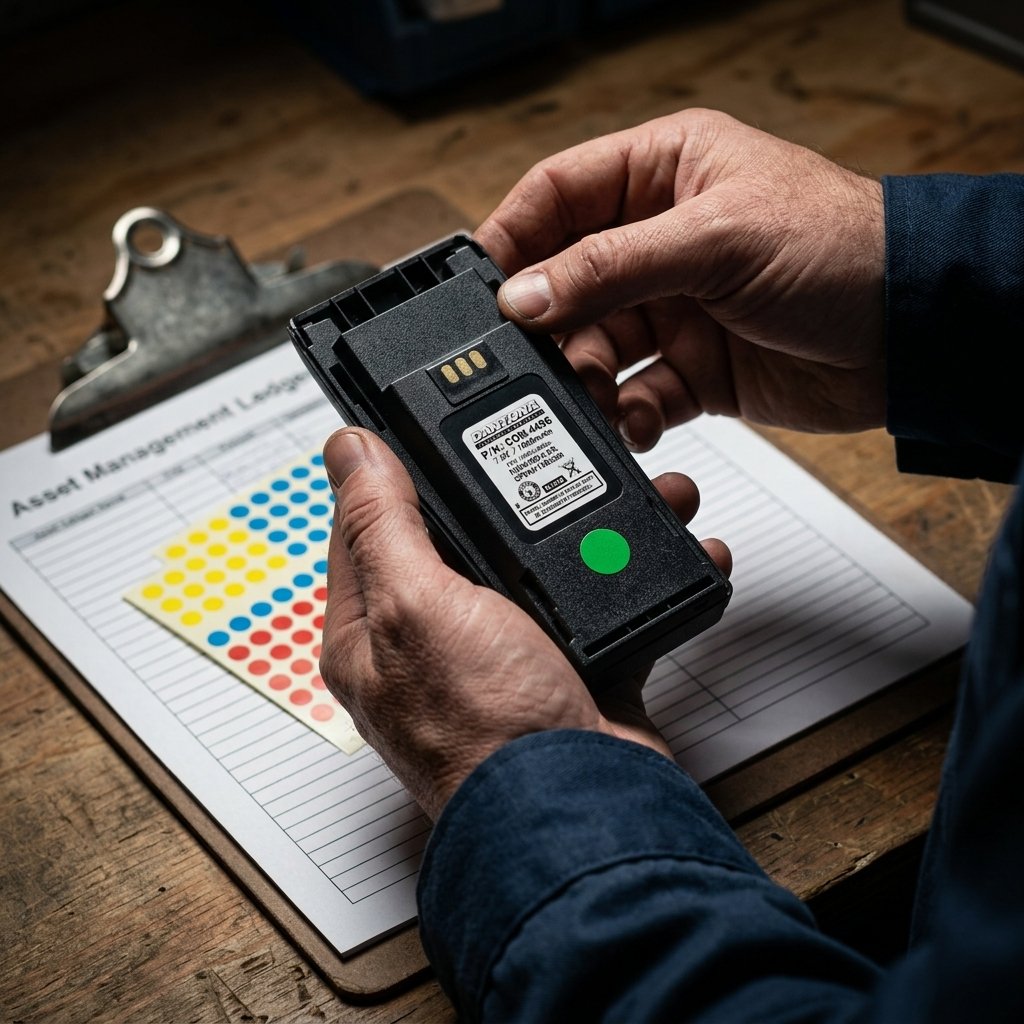
- Commissioning Date Stamping: The true lifecycle clock begins when the battery undergoes its initial conditioning charge. Upon unpacking a new batch of batteries, facilities teams should immediately etch or permanently mark the Commissioning Month and Year directly onto the housing.
The Color-Coded Annual Rotation Matrix
To eliminate manual record-keeping in large fleets, facilities operations should adopt a visual Color-Coded Commissioning Matrix. By applying a durable, high-visibility colored vinyl dot or wrap to the base of every battery upon commissioning, supervisors can immediately audit the age of any handset across the facility at a glance.
[Yellow Tag: Commissioned 2024] ──► Active / Prime Shift Fleet
[Green Tag:  Commissioned 2025] ──► Active / Prime Shift Fleet
[Blue Tag:   Commissioned 2026] ──► Active / Prime Shift Fleet
[Red Tag:    Commissioned 2023] ──► DECOMMISSION / RECYCLE IMMEDIATELY
When a supervisor conducts a shift pass-off, any battery displaying an expired color code (e.g., Red in 2026) is pulled from service immediately, regardless of whether it appears to hold a charge. This visual audit method prevents old, degraded batteries from sneaking back into active duty racks.
Two-Way Radio Battery Chemistry Health
Evaluating battery performance across different chemistries requires clear benchmarks. Use this comparative framework to guide decommissioning decisions across your fleet:
| Battery Metric & Parameter | Lithium-Ion (Li-ion) | Lithium Polymer (Li-Po) | Nickel-Metal Hydride (NiMH) |
| Average Functional Lifespan | 18–24 Months (300–500 cycles) | 18–24 Months (300–400 cycles) | 12–18 Months (250–400 cycles) |
| Self-Discharge Rate (per month) | Low (1%–2% per month) | Low (2%–3% per month) | High (10%–20% per month) |
| Memory Effect Vulnerability | None | None | Moderate (requires periodic deep discharge) |
| Primary Failure Mode | High internal resistance; sudden voltage collapse under PTT load | Physical swelling, gas buildup, housing distortion | Capacity drop due to crystalline formation (“memory”) |
| Primary Environmental Enemy | High heat (>110°F / 43°C) while fully charged | Physical puncture, extreme heat, swelling | Deep discharge storage below 0% state-of-charge |
| Hard Decommissioning Trigger | Capacity drops below 80% of rated mAh, OR reaches 24 months from commissioning date | Any visible swelling/warping, OR capacity drops below 80% rated mAh | Capacity drops below 70% rated mAh, OR reaches 18 months from commissioning date |
Establishing a Hard Rotation and Decommissioning Schedule for Two-Way Radio Battery Management
Managing a fleet requires moving away from reactive replacements and establishing a strict, scheduled rotation pipeline.
1. The Two-Tiered Fleet Rotation (Primary vs. Secondary)
Instead of running batteries to total failure, adopt a two-tiered operational model. Brand-new batteries (Months 1–18) are assigned exclusively to high-demand, 24/7 departments like Security, Emergency Response, and Facilities Engineering. At Month 18, shift these units to low-demand, single-shift departments like Administrative Support or Event Staff, where a reduced duty-cycle window will not compromise safety.
2. Automated Capacity Conditioning
Deploy smart multi-unit charging banks equipped with automated capacity testing. Modern smart chargers analyze true milliamp-hour (mAh) delivery under simulated discharge loads. If a battery tests below 80% of its factory-rated capacity during a routine maintenance cycle, the charger flags a red fault light, signaling the operator to remove it from circulation.
3. Environmental and Storage Controls
Store backup battery inventory in a dry, climate-controlled space held between 60°F and 70°F (15°C to 21°C). Spare Li-ion stock should be stored at a 40% to 60% State-of-Charge (SoC)—never fully depleted and never sitting indefinitely on continuous trickle chargers.
Hardening Enterprise Power Infrastructure
Communication failures during field operations are rarely caused by system-wide network outages; they are caused by forgotten, aged batteries collapsing under pressure. By decoding manufacturer date codes, establishing visual color-coded tagging, and enforcing a strict 18- to 24-month hard retirement rule, facilities directors can guarantee reliable radio coverage across every shift.
To learn more about optimizing physical assets and streamlining field operations, explore our Facility Ops guide. For deeper insights into managing wireless systems, emergency dispatch, and two-way radio infrastructure, browse our dedicated Communications Category.
One thought on “Enterprise Battery Lifecycle & Aging Protocol: Eliminating Silent Radio Failures in Facility Operations”